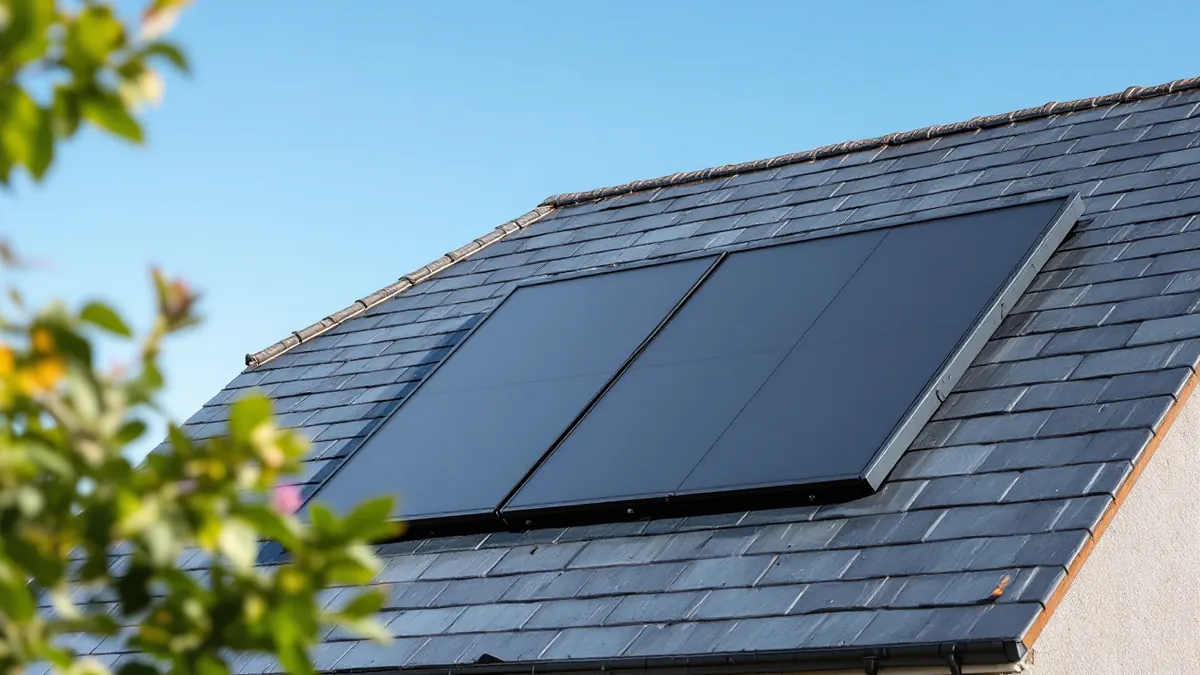
In roof solar panels sit flush with your roof, in place of tiles or slates. On-roof panels bolt on top of the existing covering. Both make the same electricity, so the choice is mostly about looks, cost and roof condition.
This guide compares the two options in plain English. It covers how each is built, what each costs to think about, and which homes suit which. If you want to see how sizing works first, start with our guide on how many solar panels you need.
What is the difference between in-roof and on-roof solar panels?
On-roof panels are the standard choice. Metal rails are fixed to the roof structure through the tiles, and the panels sit on the rails a short distance above the roof surface. The tiles stay in place underneath.
In-roof panels, also called integrated panels, take the place of the tiles or slates. They sit level with the roof and form part of its waterproof layer. As a result, the roofing and the solar work have to fit together exactly.
The Energy Saving Trust lists the main cost drivers of a solar job. They include roof access, whether you choose panels or tiles, whether you integrate the panels into the building, and whether you need to renew the roof covering. In-roof panels touch several of those at once.
How do they look?
Looks are a common reason to choose in-roof panels. A flush array looks tidy, especially on a dark roof, because it avoids the raised gap beneath on-roof panels. On some homes, looks decide whether an owner goes ahead with solar at all.
On-roof panels are more visible because they sit proud of the tiles. However, modern panels with black frames and black cells blend in far better than older designs. On a plain roof with a neat layout, many owners find the on-roof look perfectly good.
Layout matters more than the type. A rectangle of panels that follows the roof lines looks better than a scattered patch. Our bespoke solar system design service starts with the roof so the layout looks right.
What do they cost?
In-roof panels are a different and usually costlier job. They replace part of your roof covering, so there is more labour and more material involved. For that reason we do not quote a fixed premium here, because it varies too much from roof to roof.
For context, a typical 4 to 4.5 kWp on-roof home system typically costs roughly £6,000 to £8,000 installed, according to the Energy Saving Trust, MCS and government cost data. Ask for in-roof as a separate line, so you can see the difference for your own roof. Our full guide to solar panel costs explains what sits behind those numbers.
The picture changes if the roof covering is already due for renewal. In that case, in-roof panels replace tiles you would have bought anyway, so part of the cost overlaps. Therefore, compare the whole project, not just the panels.
Battery plans matter here as well. If you want storage, the same planning applies. Our guide to solar battery storage costs covers sizing and prices.
How do they perform?
Panels do not make more power just because they sit in the roof. Output depends on three things: which way the roof faces, its pitch, and shade. A south-facing roof at a 30 to 45 degree pitch is ideal. East or west roofs typically still make about 80% as much.
We modelled this with PVGIS for a Birmingham roof. A south-facing roof at 35 degrees scores 100%. Facing south-east gives about 95%, and facing east or west gives roughly 80%. A flat roof at zero degrees gives about 83%.
Heat is a fair question, since on-roof panels have an air gap beneath and in-roof panels do not. We do not claim a fixed difference either way. Instead, your designer should address it in the specification.
Seasons matter more than mounting. Output falls a lot in winter, whichever type you pick. Our article on whether solar panels work in winter shows the monthly pattern.
What are the roof and weatherproofing risks?
With on-roof panels, the risk lies in the fixings, since each rail bracket passes through the tiles and a careless job can let water in. A good installer seals and flashes every point.
With in-roof panels, the panels are part of the weatherproofing. Therefore, the quality of the install, the seals and the flashing around the edge matters even more. A poor job can leak.
Either way, a competent person must check that your roof can carry the panels before installation. That check matters most on older or unusual roofs, while workmanship matters too, so ask what cover applies. Pier Solar arranges manufacturer product warranties plus an extended workmanship warranty.
Does planning permission change?
Most homes can add solar panels as permitted development. The rules differ in England, Scotland and Wales, and they can change. For example, England’s rules changed on 27 August 2026. Our guide on planning permission for solar panels sets out the current position.
A listed building needs consent before you add solar panels. In a conservation area, panels on street-facing walls are restricted, and you should check the rest with the council. Some owners of these homes prefer in-roof panels for their tidy look. Even so, they still need the same checks.
Which should you choose?
The right answer depends on your roof and priorities. This list gives a fair starting point.
- Choose on-roof if you want the lowest cost, an easier fit and simple repairs later.
- Choose in-roof if looks matter most, or if the roof covering needs renewing anyway.
- Choose on-roof if your roof is in good order and you want flexibility.
- Ask for both quotes if you are unsure, and compare the full project.
An easy mistake is to choose on looks alone. A simpler system that fits your budget can beat a perfect one that does not.
Choosing a design partner
Pier Solar designs and specifies your system, and vetted MCS-certified partners install it. We would look at your roof, shade, use and budget before recommending either type. Our panel and inverter installation service covers the equipment side.
Your own home matters most. For instance, a terrace in solar installation in Manchester has different needs from a detached house, while a period property in solar panels in Leeds may bring heritage questions. If you are weighing solar installation in Birmingham, ask your designer to model both options.
Charging a car adds another layer of choices. Our guide to charging an EV from solar panels explains how that fits in.
When you are ready, send Pier Solar an enquiry through the online form.
Sources
- Energy Saving Trust — Solar panels for your home
- MCS — Solar photovoltaic (PV) panels
- MCS — MIS 3002 Solar PV Systems installation standard
- European Commission JRC — PVGIS photovoltaic geographical information system
- DESNZ — Solar PV cost data
- Planning Portal — Planning permission for solar equipment mounted on a house