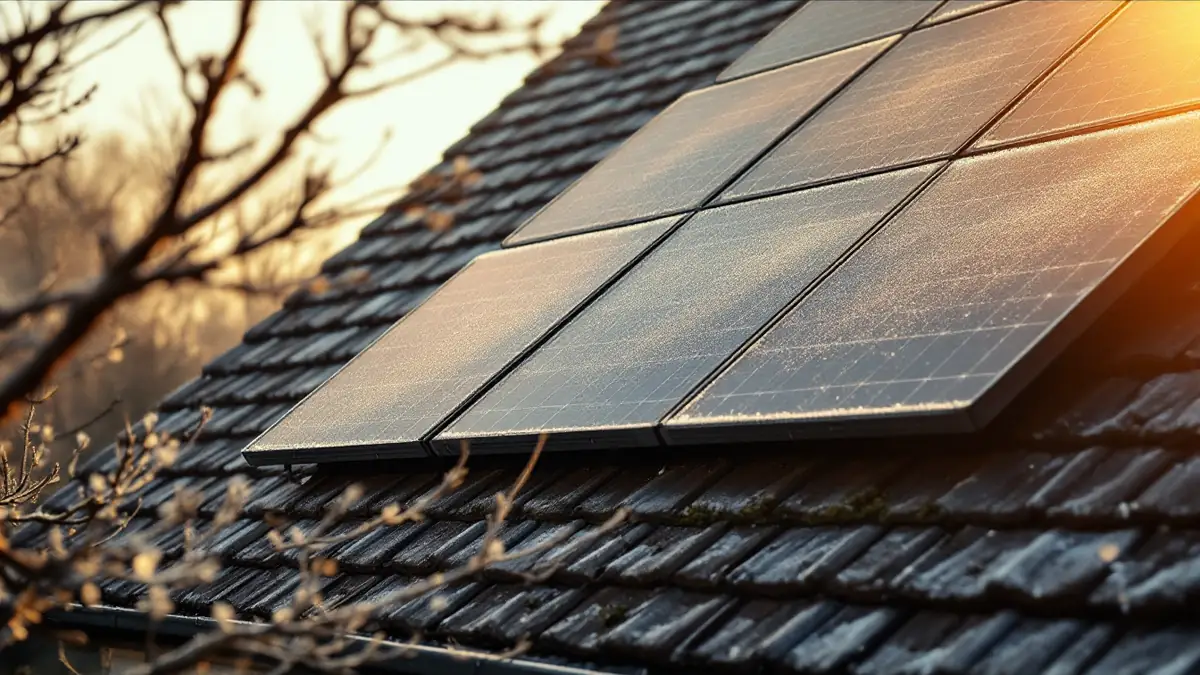
Do solar panels work in winter? Yes, they do. They make less power in the dark months, but they keep generating on cloudy and cold days. Understanding the seasonal pattern helps you set realistic expectations before you buy.
Panels need daylight, not heat. Cold weather does not stop them, and short days and low sun are what cut output. This guide shows how much the UK’s seasons change what you get, using real modelled data.
How much do solar panels make in winter?
We used PVGIS, the European Commission’s solar tool, to model 1 kWp of panels in Birmingham. The roof faces south at a 35 degree pitch, and the model allows for 14% system losses. The system makes about 969 kWh over a full year.
Here is the monthly picture:
| Month | Output (kWh) | Share of the year |
|---|---|---|
| January | 36.7 | 3.8% |
| February | 51.5 | 5.3% |
| March | 85.3 | 8.8% |
| April | 107.5 | 11.1% |
| May | 117.7 | 12.2% |
| June | 116.2 | 12.0% |
| July | 119.0 | 12.3% |
| August | 105.7 | 10.9% |
| September | 90.8 | 9.4% |
| October | 61.6 | 6.4% |
| November | 42.7 | 4.4% |
| December | 34.2 | 3.5% |
Panels still generate in winter and on cloudy days, but December output is typically about a third of July’s. May to August makes roughly 47% of the year. November to January makes roughly 12%.
These are modelled estimates, not guarantees. Your own roof, shading and local weather will shift the numbers. Other places will differ in the detail.
What happens on cloudy days?
The Energy Saving Trust says solar panels work even on cloudy days. Cloud blocks some light, so output drops, but it does not fall to zero. Bright overcast skies still deliver useful power.
Think of it as a dimmer, not a switch. A dull day gives you a fraction of a sunny day. Across a year, the UK’s cloudy days add up, and the yearly figures above already include them.
That is why sizing and placement matter more than the weather. Our guide on how many solar panels you need shows how to size a system for your use, not for a perfect day.
What about snow, frost and rain?
Heavy snow can cover panels and pause output until it clears. Please do not climb onto a snowy or icy roof to clear it, since the risk of a fall is far worse than a few lost kilowatt hours.
Rain is helpful. The Energy Saving Trust notes that panels tilted at 15 degrees or more are self-cleaning in UK rain. As a result, winter weather often leaves panels cleaner than before. Our article on solar panel maintenance and cleaning covers when to step in.
We do not make claims about frost raising output. We have no solid UK source for that, so we leave it out.
Does roof direction matter more in winter?
It can. The sun sits low in winter, so a clear view of it matters. A south-facing roof at a 30 to 45 degree pitch is ideal. East or west roofs typically still make about 80% as much.
Shade is a bigger problem too. A tree or chimney that barely touches the roof in summer can cast a long shadow in December. For that reason, a site visit should check winter shading, not just summer views.
Our PVGIS runs for Birmingham show how angle changes the year. A south roof at 15 degrees makes about 93% of the best case. A vertical south-facing surface makes about 73%. For most homes, total yearly output matters more than the winter figure alone.
Why total yearly output still looks good
Low winter output sounds like a problem, and yet panels still pay their way. Most of the energy comes from spring to autumn, when days are long. In the UK, a well-placed 1 kWp of panels typically makes about 850 to 1,150 kWh a year, depending on location.
The Energy Saving Trust puts payback at roughly 9 to 12 years in its example locations. That figure already allows for winter. Panels should typically last 25 years or more, so the long summers of later years add up to a good return.
Winter does have a cost side. You use more power for lighting and heating, but your panels make less. As a result, you buy more from the grid exactly when the price signal matters. The Ofgem price cap electricity rate is about 26p per kWh from October to December 2026, so each unit you do generate is valuable.
How to make the most of winter solar
You cannot change the sun. However, you can change how well you use what you get.
- Run appliances such as the washing machine or dishwasher in the middle of the day.
- Use a smart meter and an app to see when your panels are producing.
- Add a battery if you are often out during the day, so you can use midday power in the evening.
- Check you have an export tariff for any spare power. The Smart Export Guarantee pays you for surplus solar electricity you send to the grid.
A battery can store midday power for the evening. Our guide to solar battery storage costs shows what to expect, and our battery storage service explains how Pier Solar specifies one. Our explanation of the Smart Export Guarantee covers selling surplus power. Each supplier sets its own export rate, so compare tariffs.
If you have an electric car, winter charging is where timing counts most. Our guide to charging an EV from solar panels covers how to match charging to your output.
Watching your winter output
A monitoring app tells you what the weather cannot. You can see each day’s output and compare year on year. If a December is much weaker than last year, you can then ask whether the weather or a fault is to blame.
Our smart energy monitoring service gives you that picture in plain language. Good monitoring also helps you shift your use to match the sun.
Winter solar in different UK cities
Output changes across the country. Northern and Scottish homes see less than southern ones all year. For example, PVGIS puts the best-angle yield of 1 kWp in Glasgow at about 850 kWh a year, against about 950 in Sheffield and 970 in Liverpool.
If you are comparing solar installation in Liverpool, solar panels in Sheffield or solar installation in Glasgow, expect a winter dip and plan for it. A tailored design will tell you more than a national average.
To discuss your own roof, send Pier Solar an enquiry through the online form.