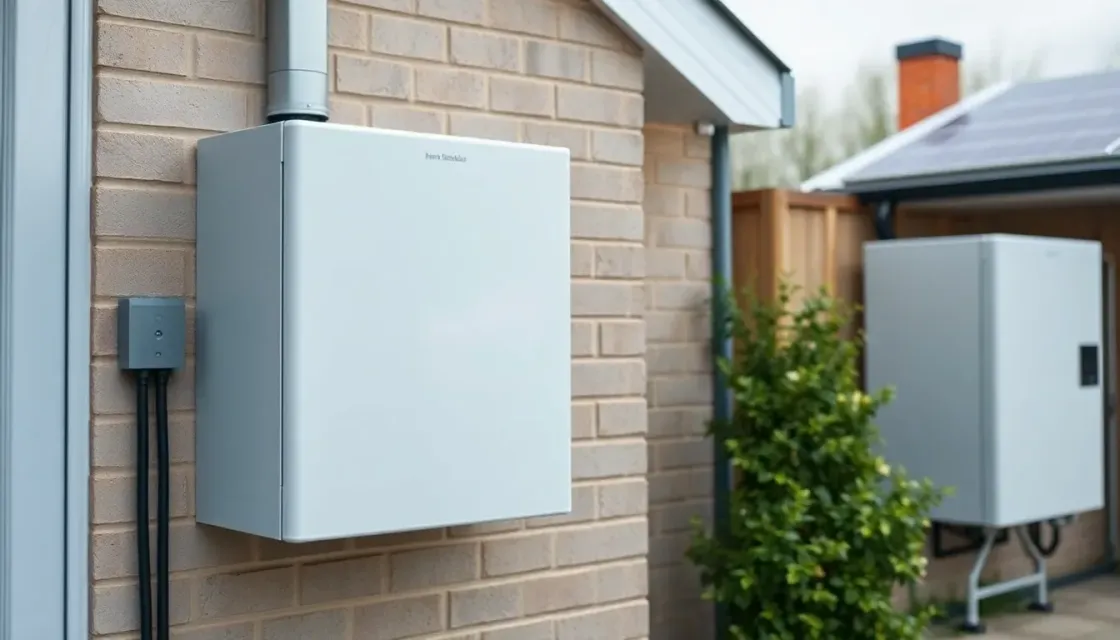
A home battery stores spare solar power for later. Without one, panels make most of their energy in the middle of the day, while many households are out. The surplus goes to the grid. A battery holds it back, so you can use it after dark.
Pier Solar designs and specifies battery systems for homes and small businesses. Vetted, MCS-certified installation partners then fit the equipment. Specifically, this page explains what a battery does, what it costs and how to compare quotes.
What a solar battery does
Your panels feed your home first. Anything extra charges the battery. When the panels stop producing, the battery supplies the house until it runs low. Only after that does your home draw from the grid, so the bill falls.
The benefit depends on your habits. A household that is busy in the evening gets more from a battery than one that is home all day. In the second case, the panels already cover much of the use, therefore a battery adds less.
A battery is not backup power by default. Most systems switch off in a grid outage unless they have a backup circuit. If you want that, say so at the start, because it changes the design.
What a battery typically costs
The Energy Saving Trust gives a wide range for home batteries, from about £1,500 up to £10,000. Size is the main driver. It also says a typical home system might be 10 kWh. Meanwhile, Which? quotes retail starting prices from about £2,500.
Batteries fitted with solar panels, or added later, are covered by the same VAT relief as panels. Installing solar in a home in Great Britain is currently VAT-free until 31 March 2027. However, from 1 April 2027 the rate is due to return to 5%, unless the government changes it. Business buildings are not covered, so check with an accountant.
For the bigger picture on returns, read our guide on whether solar panels are worth it in the UK. It sets out the Energy Saving Trust payback examples, which run at roughly 9 to 12 years, while explaining what drives the difference.
How Pier Solar sizes a battery
We start with your electricity use, not a catalogue. A typical home uses about 2,500 kWh a year, according to Ofgem, yet real homes vary a lot. We look at when you use power, how big the array is and what you want from the battery.
Then we decide the usable capacity. A battery that is too large costs more and rarely fills in winter. One that is too small still sends solar power to the grid. As a result, the aim is a size that fills most days and empties most evenings.
We also choose how the battery connects. A DC-coupled battery shares a hybrid inverter with the panels. An AC-coupled battery has its own inverter and suits adding storage to an older array. For example, our guide to string, micro and hybrid inverters explains the trade-offs in plain terms.
Grants and export income
There are no dedicated UK Government solar panel grants, so be wary of anyone who claims otherwise. Some low-income households in England may get solar through the Warm Homes: Local Grant, although batteries are not named on that application page. Our overview of solar panel grants and schemes shows what is open now.
A battery can also work with the Smart Export Guarantee. This pays you for surplus power you send to the grid, and each supplier sets its own rate. You normally need an MCS certificate and a meter that records exports, so check both.
What to check when comparing quotes
Battery quotes are easy to make look cheap. These points make them comparable:
- Usable capacity, not just the headline figure in kWh.
- Power output, because a small output cannot run a kettle and oven together.
- Coupling type, and whether it needs a new inverter.
- Backup, and which circuits it would cover.
- Warranty terms, including years and cycles covered.
- MCS certificate, which should arrive within about ten working days of completion.
Ask for the design assumptions in writing. A good quote shows the expected use, the size of the array and the reasoning behind the battery choice. Otherwise, you cannot compare two prices fairly.
Where batteries work well
Batteries suit homes with high evening use, electric vehicles or time-of-use tariffs. For instance, a battery pairs well with an EV charger installation because a car adds a large, flexible load. It can charge from stored solar power overnight.
Storage is also easier to add at the same time as panels. One visit, one design and one set of paperwork keep costs down. Since many homes already have panels, we can also assess whether a retrofit makes sense.
To check the system after install, add smart energy monitoring. It shows how often the battery fills and empties, so you can see whether the size was right.
Battery projects across the UK
Roofs and tariffs differ by region, so the right battery differs too. Heritage rules shape what is possible in solar installation in Edinburgh, because conservation areas limit visible panels. Meanwhile, our page on solar panels in Bristol covers the local planning picture. Similarly, solar installation in Nottingham starts from your own usage and roof.
Next steps
Send your details through the online enquiry form. Tell us your roof, your usage and what you want the battery to do. We will return a design and specification, and our partners then price it.
Frequently Asked Questions
- It depends on your evening use and the size of your array. The Energy Saving Trust says a typical home system might be 10 kWh. We size yours from your real usage.
- Usually, yes. The main question is how it connects to your current inverter. We check this before we specify anything.
- Not by default. You need a system built with a backup circuit, and it only covers the circuits you choose. Tell us at the start if you want it.
- The Energy Saving Trust says home batteries typically last about 10 to 12 years. Warranty terms vary by manufacturer, so compare them in each quote.