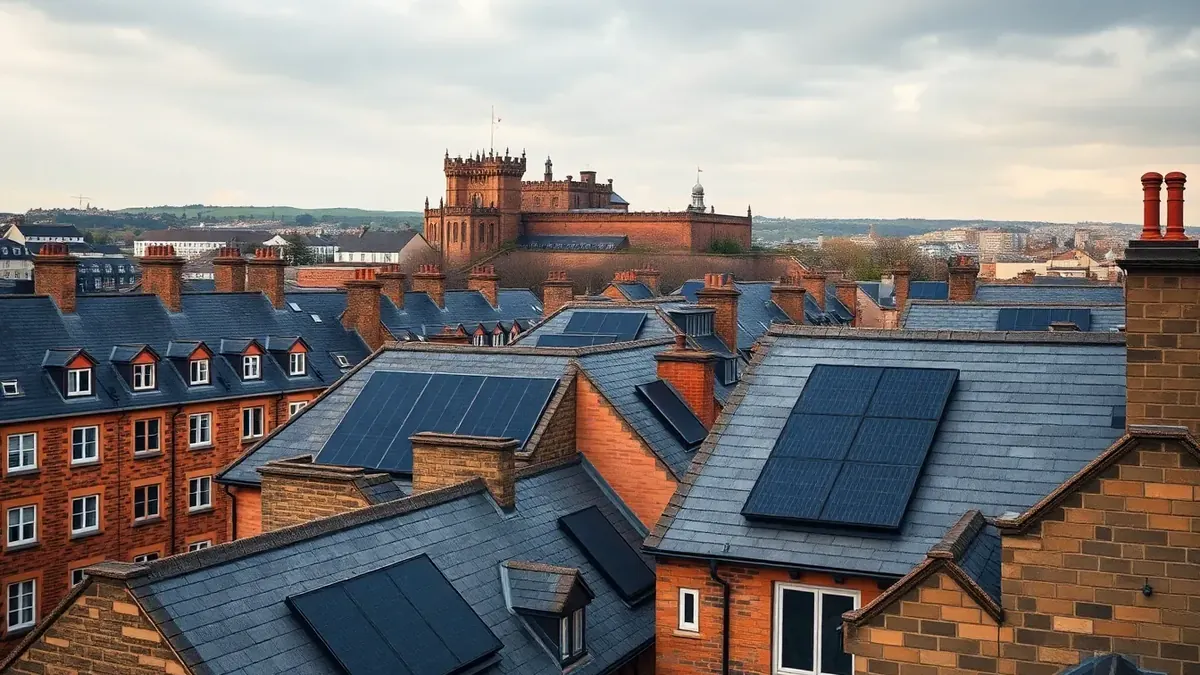
Most UK homes can fit solar panels without applying for planning permission. In England, Scotland and Wales, roof panels on a house are usually permitted development. That means you can fit them without a full application, as long as you stay within set limits.
The limits do differ by nation, and England changed its rules recently. This guide sets out the main points for solar panels planning permission, and shows where you must check with your council first. It is general information, so always confirm your own case with your local planning authority.
The short answer
For a typical house with a normal roof, you probably do not need a planning application. Your panels must stay inside the size and position limits for your nation. Your home must not be listed, and you should also check for local conditions that remove these rights.
However, the common exceptions are listed buildings, some conservation areas, flats and homes with an Article 4 direction. An Article 4 direction is a council order that removes permitted development rights in a set area. Planning conditions on a newer home can have the same effect.
England: the rules from 27 August 2026
England updated its permitted development rules through an amendment order, SI 2026/896. It came into force on 27 August 2026. The rules below apply to a house, or to a building in its grounds.
| Where | Main limit in England |
|---|---|
| Pitched roof | Panels stick out no more than 20 cm and stay below the highest part of the roof |
| Flat roof | The highest part of the equipment is no more than 60 cm above the roof |
| Wall, balcony or roof enclosure | Set limits on how far panels stick out, which your installer checks |
| Ground-mounted array in a garden | Up to 9 square metres of panels, with height limits |
| Listed building | Not permitted development, so you need consent |
| Conservation area | Panels on street-facing walls are restricted, so check with the council |
Panels should also be sited, as far as practicable, to limit their effect on the look of the area. Since the rules expect removal, take the panels down if you stop using them.
The new order also covers plug-in solar, which connects through a standard plug and socket. It does not allow plug-in units on timber walls, balconies, fences or timber-clad homes. If your scheme fitted the old rules but not the new ones, a transition period still lets you use the old rules until 26 August 2027.
Ground-mounted panels in a garden
A small array on the ground can also be permitted development. The surface area of the panels must not exceed 9 square metres. Height limits also apply, and they depend on how close the array is to your boundary and your road.
Ground arrays are not allowed in the grounds of a listed building. In some conservation areas you need prior approval first. Because the details are fiddly, for example the height bands, ask your designer to check the exact position against the order before you commit.
Scotland: Class 6HA
Scotland has its own rule. Class 6HA came into force on 24 May 2024. It makes solar PV or solar thermal on a dwelling permitted development.
- No part of the system may stick out more than 1 m from the wall, roof plane, ridge or chimney.
- The home must not be inside the grounds of a listed building.
- In a conservation area, panels may go only on rear elevations, or side elevations that do not face a road.
- You must remove the system when it is no longer in use.
In short, most Scottish homes can add solar without a planning application. Listed buildings and conservation areas have extra limits. Do not apply the English figures to Scotland.
Wales
Welsh householder guidance gives different limits again. Panels should project no more than 200 mm from the roof or wall, and they must stay below the ridgeline. On a flat roof, panels need to sit at least 1 m from the edge and no more than 1 m above the roof plane.
Listed buildings in Wales need planning permission and listed building consent. In a conservation area, panels on front or side walls visible from the street need consent. The Welsh Government may update its pages, so read the current guidance before you start.
Conservation areas and listed buildings
These are the cases that cause most delays. A conservation area does not ban solar outright. However, roof rules differ by nation and by council, so you cannot assume that a roof is fine.
Local councils also publish their own guidance. For example, Brighton and Hove says pitched roofs in its conservation areas are generally permitted development. It also lists five areas where an Article 4 direction means you need planning permission. For a listed home, you need consent. Edinburgh’s council says solar will not normally be permitted on visible elevations of listed buildings and in conservation areas.
Flats and shared buildings
Flats follow a separate set of rules. Your roof is usually owned by the freeholder, so you need their agreement as well. Plan this early, because the lease may limit what you can change.
Other approvals you may need
Planning is only one part of the process, and two other steps matter.
- Your roof needs checking. A competent person must confirm it can carry the panels before installation.
- Your local network operator needs to know. Small systems up to 3.68 kW per phase are notified within 28 days of installation. Bigger systems need approval before the installer connects them.
Your installer normally handles the network paperwork. Meanwhile, our partners also handle the MCS paperwork, and our guide to MCS certification shows why that certificate matters.
How we handle it
Pier Solar designs and specifies each system, and vetted MCS-certified partners install it. Our bespoke solar system design service checks your roof, your area and the planning limits before the design is final. If a design needs consent, we say so early. Our MCS-certified installations service then covers the build and the paperwork.
Planning is one of the first checks on any job. Although it comes first, it also helps to know the cost, so read how much solar panels cost in the UK. Then look at whether solar panels are worth it for your home. If money is tight, solar panel grants and schemes explains what help exists. How many panels you need tells you how much roof space to plan for, and solar panel maintenance and cleaning covers the upkeep afterwards.
Local planning authorities
Your council decides on any application, and each one has its own web page on solar. A large city can also have conservation areas that change the answer street by street. For instance, in London, the planning authority varies by borough, because there are 32 borough councils plus the City of London. Read about solar panels in London for local detail. Similarly, the same is true of solar installation in Birmingham and solar panels in Manchester, where the city council is your first stop.
If you are unsure, ask the council before you order a design. A written answer is worth having, because it protects you later. Still, the rules are the council’s to apply, so treat this guide as a starting point.
Next steps
- Find out whether your home is listed or in a conservation area.
- Check for an Article 4 direction on your street.
- Ask your designer to check the limits for your nation.
- Use our online enquiry form to start a design.
Sources
- Legislation.gov.uk: The Town and Country Planning (General Permitted Development) (England) (Amendment) Order 2026
- Planning Portal: Solar equipment mounted on a house or block of flats
- Scottish Government: Householder permitted development rights, Circular 1/2024
- Welsh Government: Planning permission for solar panels
- Brighton and Hove City Council: Installing solar panels at your home
- City of Edinburgh Council: Listed buildings and conservation areas
- National Grid Electricity Distribution: Micro-generation (G98)