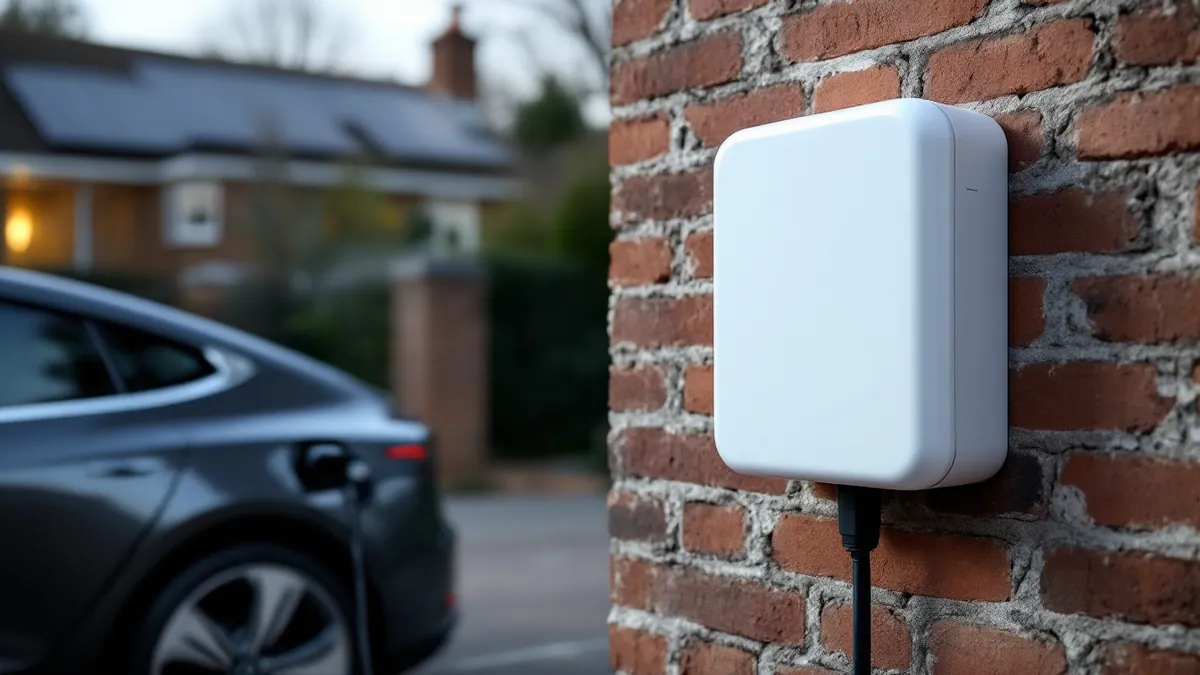
Can you charge an EV from solar panels? Yes, and for many drivers it makes good sense. Your panels make power in the day, your charger uses it, and the grid fills any gap. The trick is timing, because panels peak when many people are out.
This guide explains how solar and EV charging work together, what hardware you need, and how to get more of your car’s power from the sun. It also covers the rules, so you know what to expect before you order.
How does solar charging work?
There is no separate wire from the roof to the car. Your solar panels feed your home’s electricity. Your charger draws from the same supply as every other appliance.
In practice, the home uses your solar power first, then takes the rest from the grid. Therefore, if your panels make more than the home needs, a charger can take that extra. If they make less, the grid tops it up.
That means a solar-powered car is really a mix. For example, a car charged on a bright afternoon runs mostly on your own power. A car charged on a dark evening runs on grid power, unless a battery steps in.
Will your panels make enough?
A typical home system is around 4 to 4.5 kWp, according to the Energy Saving Trust. Most home chargers are 7 kW or less. Standard AC chargepoints are 3.5 to 7 kW, according to the government’s minimum specification.
A 7 kW charger can therefore draw more than a 4 kWp system makes even at its very best. Panels rarely hit their peak, either, so on most days a charger running at full speed takes some power from the grid. A slower charge, or a charger that adjusts its speed, can match your output better.
Yearly output helps with the bigger picture. In the UK, a well-placed 1 kWp of panels typically makes about 850 to 1,150 kWh a year, depending on location. Our guide on how many solar panels you need shows how to size a system when you add a car to your electricity use.
Timing is the big issue
Solar makes the most power around midday. Many people charge cars at night, when they are home. Because the two do not line up, solar often covers less of your charging than you might hope.
You have three main ways to close the gap:
- Charge at home during the day, if you work from home or the car is parked.
- Use a charger that follows your solar output and adjusts its speed to match.
- Add a home battery, so midday power is saved for the evening.
Seasons matter too, since winter output is much lower than summer output. Our article on whether solar panels work in winter shows how large the gap is, so you can plan a realistic share.
Smart chargers and the rules
Home chargepoints sold in Great Britain must be smart-capable under the 2021 regulations. They must have preset default charging hours outside the peak, and they need a way for you to override those hours. This helps spread demand on the grid.
For a solar owner, smart features are useful in a second way. A smart charger can start when your panels are making power and slow down when clouds roll in. However, check the model, because features differ.
A smart meter and an app show how much of your charging came from the sun. Our smart energy monitoring service helps you see this in plain terms. As a result, you can tune your habits with real data.
What does installation involve?
Charger installs follow the BS 7671 wiring rules. A new charger circuit is notifiable work, normally handled by a registered electrician. A tidy install also means checking that your consumer unit can take the extra load.
Doing the solar and charger together can save time, because the same team can check your wiring once and design the system as a whole. Our EV charger installation service works with vetted partners for this.
The solar side has its own rules. Small systems up to 3.68 kW per phase are notified to the network operator within 28 days of installation. Bigger systems need network operator approval before the installer connects them. Your installer normally handles that paperwork.
Planning is another point, since a wall-mounted charger and roof panels can sit under different rules. Our guide on planning permission for solar panels explains the panel side, and you should check with your council about the charger.
Money: what does solar charging save?
Every unit of solar you use in your car saves the electricity price you would otherwise pay. The Ofgem price cap electricity rate is about 26p per kWh from October to December 2026. The cap changes every quarter, so always date any rate you use.
We do not promise a saving figure. Your result depends on your car, your mileage, your roof and your habits. However, the logic is simple: the more of your charging that happens when your panels are producing, the more you save.
Surplus power also earns something. The Smart Export Guarantee pays you for surplus solar electricity you send to the grid. Our explainer on the Smart Export Guarantee shows how it works. In general, the unit you use yourself is worth more than the unit you export.
Domestic electricity VAT is zero until 31 March 2027, which lowers the value of each unit you save. Even so, every unit you make yourself is a unit you do not buy.
Grants for EV chargers
Grants of up to £500 are open to people in flats or rented homes, and landlords, until March 2027. They are not for owner-occupied houses. Check the government page for the current rules before you rely on one.
There are no dedicated UK government grants for solar panels, according to the Energy Saving Trust. Therefore, never assume a scheme covers you, and ask each scheme directly what it pays for.
Maintenance and long-term care
A solar and charger setup needs little attention, although a few habits help. Watch your output, check the charger for error lights, and book a health check if something looks off. Our guide to solar panel maintenance covers the basics.
If you live in Scotland, the planning and funding rules differ from England’s, so read our guide on solar panels in Scotland before you plan.
Getting started in your area
Pier Solar designs the solar system around your real use, including a car if you have one. Vetted, MCS-certified partners then install it. For example, a driver comparing solar installation in Edinburgh has different winter output from one looking at solar panels in Bristol. Someone exploring solar installation in Nottingham will see different numbers again.
When you are ready, send Pier Solar an enquiry through the online form and tell us about your car and your daily routine.
Sources
- Energy Saving Trust — Solar panels for your home
- GOV.UK — Residential chargepoints: minimum technical specification
- GOV.UK — Regulations for electric vehicle smart charge points
- GOV.UK — Electric vehicle chargepoint grants
- GOV.UK — Approved Document P: electrical safety
- Ofgem — Changes to the energy price cap, 1 October to 31 December 2026
- Ofgem — Smart Export Guarantee
- SSEN — Micro-generation installations up to 3.68kW per phase