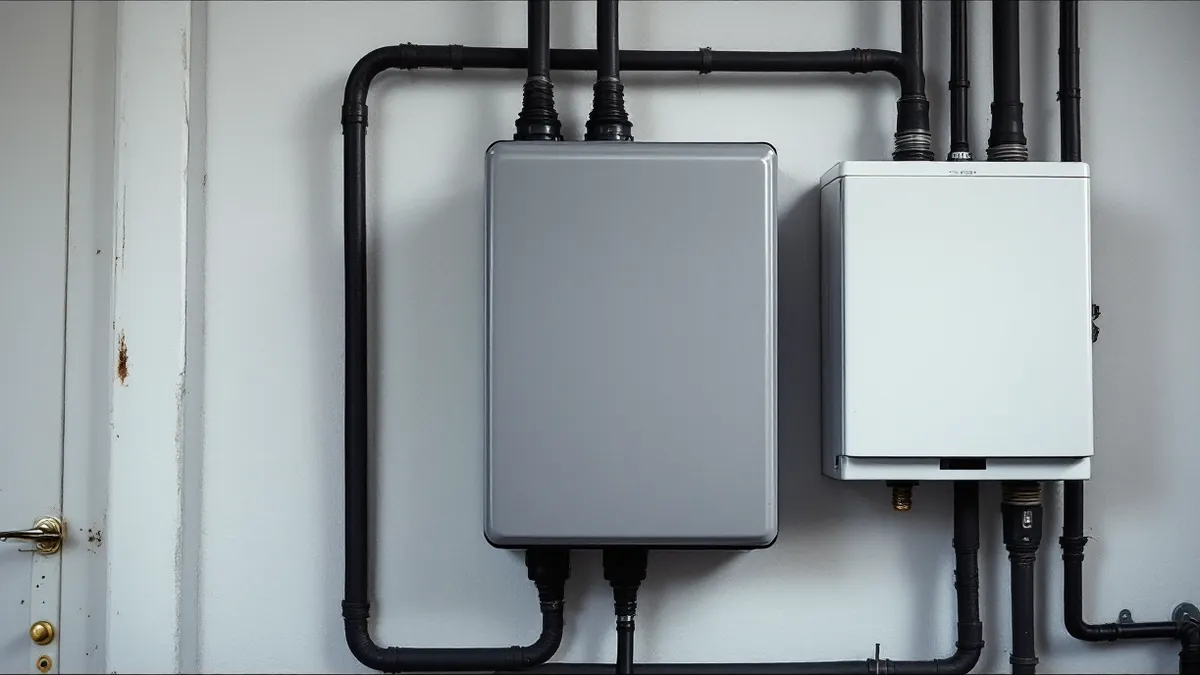
Solar inverter types are the first thing most buyers meet when they compare quotes, and the jargon can feel heavy. In short, there are three main choices: string, micro and hybrid. This guide explains what each does, where each fits, and how to choose without overspending.
The inverter matters more than its size suggests. It is the part that makes your panels useful, and it is usually the part you replace once during the panels’ life. Therefore, choosing well now saves hassle and money later.
What does a solar inverter do?
Solar panels make direct current, or DC. Your home runs on alternating current, or AC. The inverter converts one into the other.
It also watches the grid. If the grid goes down, a standard grid-tied inverter shuts off for safety, because it must not feed power into a line that engineers may be working on. For the same reason, an ordinary solar system does not keep your lights on in a power cut.
Finally, most inverters report how much your system makes. That data feeds the apps you use to track generation. Our guide on solar panel maintenance shows how to use it to spot faults.
String inverters
A string inverter is the classic choice. It is a single box, usually fitted in a loft, garage or utility room, and the panels connect to it in one or more strings. All the power from a string passes through one unit.
The main advantage is simplicity, since there is one box to install, one to monitor and one to replace. String inverters are usually the simplest route. The technology is also well proven.
The main drawback is shade. In a plain string, a shaded panel can pull down the output of the others on the same string. If your roof is clear and all panels face the same way, that matters little. However, if a chimney, tree or dormer casts a shadow, you may lose more than you expect.
Micro inverters and power optimisers
A micro inverter is a small unit fitted behind each panel. It converts power at the panel, so every panel works on its own. As a result, a shaded panel affects only itself.
Power optimisers are a middle route. They sit behind each panel too, but a central string inverter still does the conversion. Meanwhile, they let each panel work independently and add panel-level monitoring.
These options suit three situations:
- Roofs with shade from trees, chimneys or neighbouring buildings.
- Roofs with panels facing different directions, such as east and west.
- Homes where you want to see the output of each panel.
The trade-offs are cost and complexity. You pay for many small units instead of one, and there are more parts on the roof. Replacing a faulty micro inverter later also means working on the roof. Our guide to in-roof and on-roof solar panels covers other roof choices that affect this.
Hybrid inverters and batteries
A hybrid inverter handles both solar panels and a home battery in one box. It takes the DC from the panels and either sends it to the house, stores it in the battery or exports it. For a new system with a battery, it is often the neat option.
The benefit is a single, coordinated unit. It manages charging and discharging for you, so there is less equipment to fit and to look after.
However, if you already have a string inverter and want to add a battery later, you have another route. An AC-coupled battery has its own inverter and connects to your home wiring. It works alongside the existing solar inverter.
Home batteries typically cost from about £2,500 up to £10,000, depending on size, and typically last about 10 to 12 years. Home batteries installed with solar panels, or added later, also get the same VAT relief. Installing solar panels in a home in Great Britain is currently VAT-free, until 31 March 2027. Read more in our guide to solar panel grants and schemes, and see our battery storage service for how we specify one.
How long do solar inverters last?
The Energy Saving Trust says the inverter usually needs replacing after about 12 years. The panels, in contrast, should typically last 25 years or more. So plan for at least one inverter swap during the life of the system.
Warranties vary by maker. The Energy Saving Trust says inverter warranties commonly start at five years and can often be extended to 15. A longer warranty is worth weighing against the price, because a replacement is a real cost.
Where the inverter sits can affect its life, since heat is hard on electronics. A cool, ventilated spot is kinder than a hot loft. Your installer should place it with room for airflow and easy access.
Which solar inverter is right for you?
The right choice depends on your roof, your shading and your plans. However, a simple decision guide helps.
- A clear, single-direction roof and no battery plan: a string inverter is usually enough.
- Shade or split roof faces: micro inverters or optimisers deserve a close look.
- A new system with a battery: a hybrid inverter is often a good fit.
- A battery added later to an existing system: an AC-coupled battery may suit better.
Size matters too, because the inverter must match your array. Our guide on how many solar panels you need explains how array size is worked out, and the inverter follows from it.
Seasonal output also plays a part. In winter your panels make far less, so the inverter works well below its rating for long stretches. Our article on whether solar panels work in winter shows the monthly pattern.
What the rules say about inverters
Your inverter must connect to the grid safely. Small systems up to 3.68 kW per phase are notified to the network operator within 28 days of installation. Bigger systems need network operator approval before the installer connects them.
Your installer normally handles that paperwork, which is one more reason to use an MCS-certified installer. MCS is the UK quality mark for small-scale renewable installations such as solar panels, and you normally need an MCS certificate to join the Smart Export Guarantee.
Getting the inverter right with Pier Solar
At Pier Solar we design and specify the whole system, and vetted MCS-certified partners install it. We choose the inverter after we look at your roof, your shading and your plans for a battery. Our panel and inverter installation service explains how that works.
Local conditions matter. For example, a home with a leafy garden in solar installation in Milton Keynes may need different equipment from a bright, open roof. If you are comparing solar panels in Brighton or solar installation in London, shade from neighbouring buildings is worth checking.
If you would like a design with the inverter explained in plain English, ask Pier Solar through the online form.