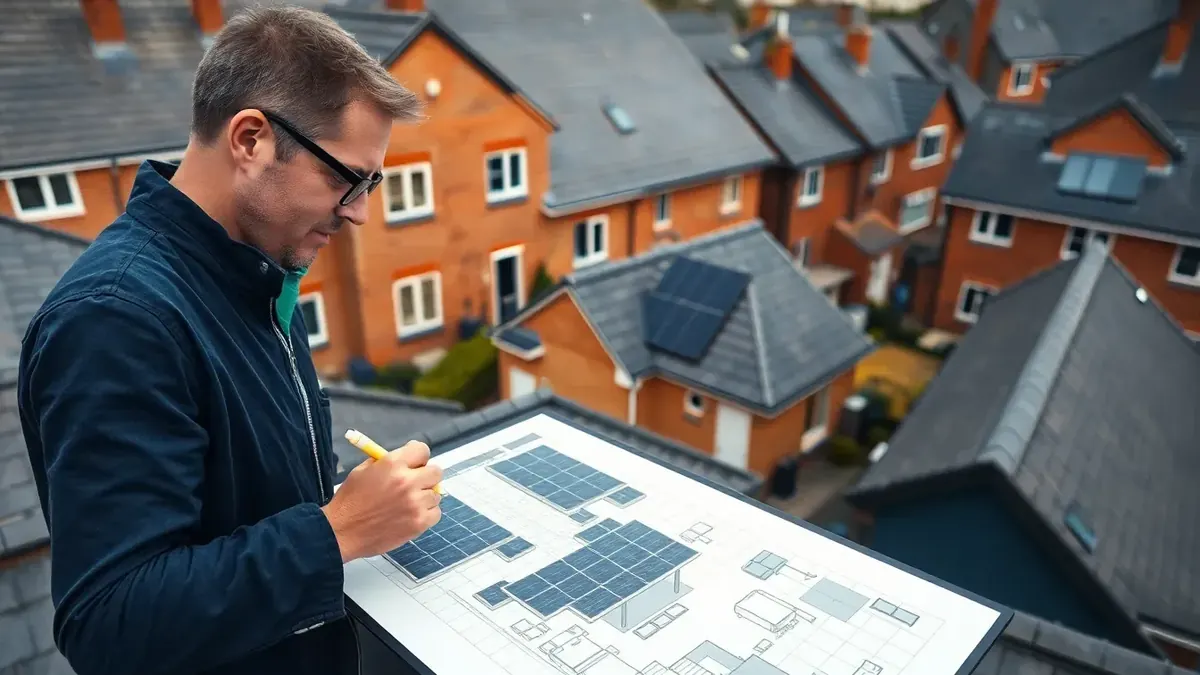
How many solar panels do I need? A typical UK home system is around 4 to 4.5 kWp, which is about nine to eleven modern panels. Your own number depends on three things: how much electricity you use, how much usable roof you have, and what you want to spend.
Bigger is not always better, and smaller is not always cheaper per unit. This guide shows how to turn your bills and roof into a sensible panel count, with a table you can check against your own home.
Start with kWp, not panel count
Installers size a system in kilowatts peak, written kWp. It is the total rated power of all the panels together. Because panel ratings vary, the same system can use a different number of panels.
The sum is simple. Divide the system size by the power of each panel. For example, a 4 kWp system built from 400 to 450 watt panels needs about nine or ten panels. A 4.5 kWp system needs about ten or eleven.
| System size | Panels of 400 to 450 W | Modelled yearly output |
|---|---|---|
| 2 kWp | About 5 | 1,700 to 2,300 kWh |
| 3 kWp | 7 to 8 | 2,550 to 3,450 kWh |
| 4 kWp | 9 to 10 | 3,400 to 4,600 kWh |
| 4.5 kWp | 10 to 11 | 3,800 to 5,200 kWh |
| 6 kWp | 14 to 15 | 5,100 to 6,900 kWh |
The panel counts are arithmetic from the ratings. The output column multiplies each size by 850 to 1,150 kWh per kWp, which is the typical UK range from the EU’s PVGIS tool. Treat the output as a modelled guide and not a guarantee.
Work out how much power you use
Your electricity bill or smart meter shows your yearly use in kWh. For context, Ofgem’s medium consumption figure for a typical home is about 2,500 kWh a year. Homes with electric heating, a heat pump or an electric car use far more.
Then compare that figure with the output column above. A 3 kWp system may match a low-use home, while a larger family might choose 4 kWp or more. However, matching the total is only half the job, because panels produce at midday and many homes peak in the evening.
Think about when you use power
Solar saves most when you use the power as it is made. If someone is home in the day, or you run a dishwasher and washing machine at midday, you will use more of your own output. Surplus power can earn money through the Smart Export Guarantee, although each supplier sets its own rate.
If you are out all day, a battery can store the surplus for the evening. That changes the sums a lot, so see our guide to solar battery storage costs and sizing before you fix the number of panels. A design that plans for storage can sometimes justify a slightly larger array.
Your roof sets the ceiling
Space limits the answer, but so do direction and shade. A south-facing roof at a 30 to 45 degree pitch is ideal. East or west roofs typically still make about 80% of the best output, so they can work well, particularly when split across two slopes.
Obstacles matter too. Chimneys, dormers, roof windows and neighbouring trees all reduce usable space or cast shade. A flat roof makes about 83% of the best output. Our comparison of in-roof and on-roof solar panels explains how mounting changes the layout.
Before installation, a competent person must check that your roof can carry the panels. This is part of the MCS installation standard, and it is one reason a site survey matters.
How location changes the output
The same panels make more power in the south than in the north. PVGIS modelling for a well-placed 1 kWp gives about 1,040 kWh a year in Norwich, 1,000 in Leicester and 910 in Aberdeen. These are modelled values at an ideal angle with 14% system losses, so real roofs make a little less.
In practice, a northern home may need a few more panels to reach the same yearly output. Our pages on solar installation in Norwich, solar installation in Aberdeen and solar installation in Leicester show how local conditions shape a design.
Should you fill the whole roof?
Many people ask whether they should simply cover every slope. Sometimes the answer is yes, but not always. Extra panels cost more, and the added power only helps if you use it or export it. Meanwhile, exports earn less than self-use, so the last few panels often add the least value.
On the other hand, fitting scaffolding twice is costly. If you expect to buy an electric car or a heat pump, it can make sense to size up now. A designer should talk this through with you, using your real use and plans. That is the purpose of bespoke solar system design.
What each size typically costs
A typical 4 to 4.5 kWp home system typically costs roughly £6,000 to £8,000 installed, based on government data and the Energy Saving Trust. Smaller systems cost less in total but often more per kW. Our breakdown of how much solar panels cost in the UK explains the range in detail.
Whether the extra panels pay back is the next question. Our article on whether solar panels are worth it in the UK helps you judge that. If cost is a worry, read about solar panel grants and schemes as well, because help is limited and narrowly targeted.
A simple way to size your system
Follow these steps, then check the result with a designer.
- Find your yearly electricity use in kWh from a bill or smart meter.
- Note when you use most power, and whether you plan a battery, heat pump or electric car.
- Check your roof direction, pitch, shade and free space.
- Pick a kWp that fits your use and roof, not just the biggest that fits.
- Divide by the panel rating to get the panel count.
Pier Solar designs and specifies each system, and vetted MCS-certified partners install it. The partner then handles the equipment, including the premium panel and inverter installation that your design calls for. To get a design based on your own bills and roof, use our online enquiry form for a solar design.
Sources
- Energy Saving Trust — Solar panels for your home
- European Commission JRC — PVGIS photovoltaic geographical information system
- Ofgem — Changes to the energy price cap, 1 October to 31 December 2026
- Department for Energy Security and Net Zero — Solar PV cost data
- MCS — Solar PV Systems installation standard MIS 3002
- Ofgem — Smart Export Guarantee