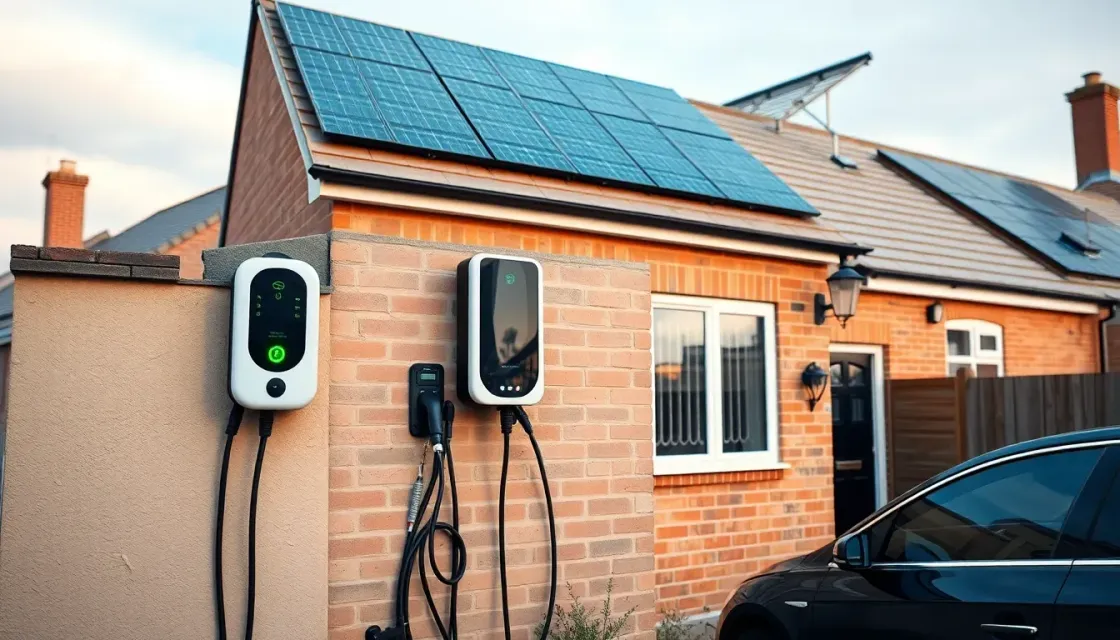
An electric car is a big new load on your home. Every mile it drives needs electricity. If you also have solar panels, you can feed part of that demand from your own roof.
Pier Solar specifies home EV chargers as part of a solar design. Vetted, MCS-certified partners install the solar system, and registered electricians handle the charger circuit. This page explains the rules, the options and how to compare quotes.
How solar and an EV charger work together
Your panels make power in daylight. A car that is parked at home during the day can charge from that supply. If the car is away until evening, a battery can hold the power until you plug in.
This is why planning matters. The right array size depends on how much driving you do, so it pays to add the car to the sums at the start, because a later upgrade costs more. Our guide to how many solar panels you need shows how extra demand changes the answer.
For a full walk-through of the options, read our article on charging an electric car from solar panels. It covers daytime charging, smart control and what to expect in winter, since output drops then.
What the rules require
Home chargepoints sold in Great Britain must be smart-capable under the Smart Charge Points Regulations 2021. They come with preset charging hours outside the weekday peaks, although you can override them. They also need basic security features.
Most home chargers are 7 kW or less, and installers fit them to the BS 7671 wiring rules. A new charger circuit is notifiable work. As a result, a registered electrician normally handles it and signs it off.
Planning rules vary by location and property type. If you live in a flat or a listed building, check with the council and your freeholder first, because separate rules apply.
What to choose
The main choice is between a tethered charger, with a cable attached, and an untethered one, where you plug in your own lead. A tethered unit is more convenient, while an untethered one is neater when you have more than one car type.
Next comes the power rating. Most home chargers are 7 kW or less, so a 7 kW unit is a common choice. A higher rating needs a bigger supply, so it rarely helps at home.
Finally, consider solar-aware charging. Some chargers can match the car's draw to your surplus solar output. Others use a simple timer. A solar-aware model costs more. However, it may raise the share of solar power the car uses.
Costs and grants
Charger costs vary with the unit, the cable run and any electrical upgrades. We give you a clear figure in the specification, so you can compare like with like. In particular, we list any consumer unit work. Because solar panels and a battery share the same VAT relief, the whole project is easier to price in one go.
Battery costs also matter if you want to charge in the evening, for instance after work. Our guide to solar battery storage costs and sizing explains what to expect. The Energy Saving Trust puts typical home batteries at roughly £1,500 to £10,000.
Grants exist, yet they are narrow. Until 31 March 2027, grants of up to £500 per socket are open to people in flats or rented homes, and to landlords. They are not for owner-occupied houses. Check the current gov.uk rules before you apply.
What to check when comparing quotes
These questions help you compare offers:
- Charger model and power rating, named in full.
- Cable run length, since long runs add cost.
- Smart features, and whether they work with your solar system.
- Consumer unit changes, such as a new board or protection device.
- Part P sign-off, so you have proof the work is notifiable and complete.
- Warranty, covering the charger and the labour.
Be cautious of quotes that bundle the charger and solar with no breakdown. Instead, you should see each part priced clearly.
How this fits with our other services
An EV charger sits naturally with battery storage systems, which let a car charge from stored solar power in the evening. It also benefits from smart energy monitoring, because you can see how much of each charge came from your roof.
Charger and solar projects across the UK
Homes differ from region to region, and so do roofs and driving habits. For example, our page on solar installation in Cardiff looks at local output and Welsh planning. Similarly, solar panels in Norwich covers the East of England. In the north, solar installation in Aberdeen explains how lower yields shape the design.
Next steps
Tell us about your car, your roof and your parking through the online enquiry form. We will return a design that covers the panels, the charger and any battery.
Frequently Asked Questions
- Not always, because winter output is lower. In winter, December output is typically about a third of July's. You will usually use a mix of solar and grid power.
- Yes, home chargepoints sold in Great Britain must be smart-capable. You can also override the preset charging hours.
- A registered electrician normally installs it, because a new charger circuit is notifiable work. Our partners handle the solar side.
- Grants are open to people in flats and rented homes, and to landlords, until March 2027. They are not for owner-occupied houses.