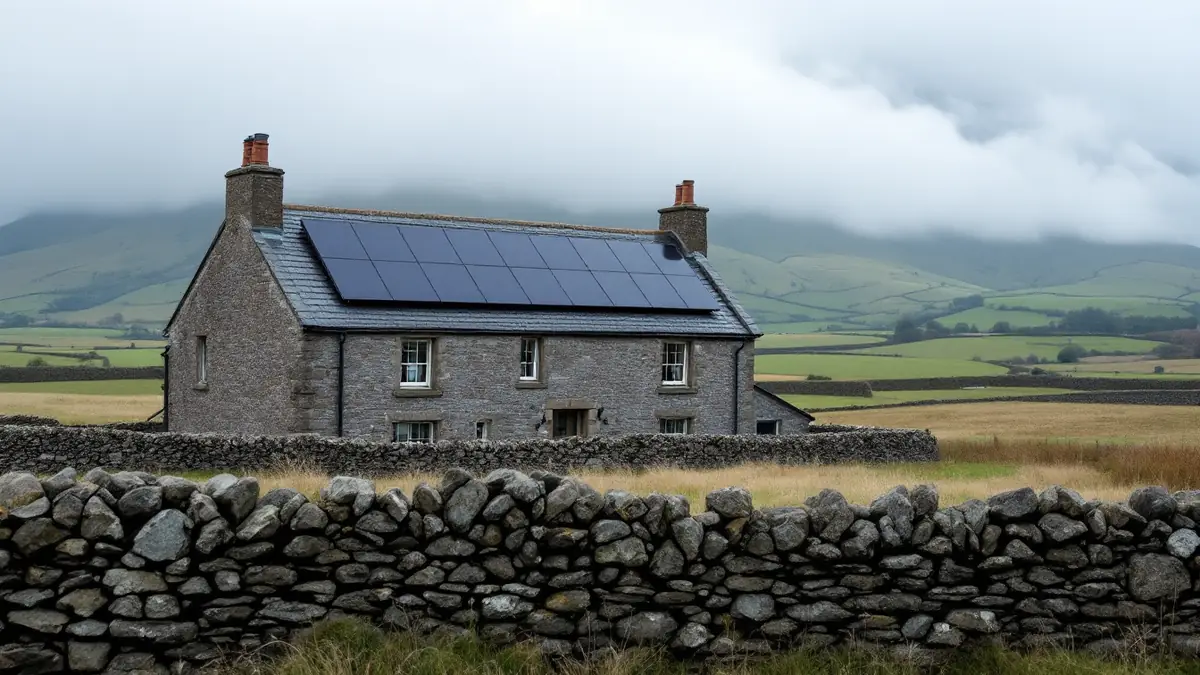
Solar panels in Scotland work, and for many homes they make sense. Output is lower than in the south of England, but panels still work. Scotland also has its own planning rules and its own home energy advice service, which matter when you plan a system.
This guide covers what to expect from your roof, how permitted development works north of the border, what help exists, and how to design a system for Scottish conditions. It gives homeowners and small businesses straight answers before they request a quote.
How much power can you expect in Scotland?
The Energy Saving Trust says panels work even on cloudy days. That is good news in a country with a lot of cloud. What changes is how much energy you get across a year.
We ran the European Commission’s PVGIS tool for Scottish towns. For 1 kWp of panels at the best fixed angle, Glasgow comes out at about 850 kWh a year. Edinburgh makes about 920 kWh and Aberdeen about 910 kWh. Across the UK, the range runs from about 850 to 1,150 kWh a year per kWp.
These figures are modelled estimates, not guarantees. Real roofs rarely sit at the ideal angle, so most homes will see somewhat less. However, roof direction and shade also change the result, so a good roof in Scotland can beat a poor roof in the south.
A typical home system is around 4 to 4.5 kWp, according to the Energy Saving Trust. Our guide on how many solar panels you need shows how to size one against your own use.
Are solar panels worth it in Scotland?
Often, yes, although the return depends on how much of the power you use yourself. Every unit you use saves the price you would otherwise pay. Units you export earn a smaller payment.
The Energy Saving Trust gives example paybacks for England, Wales and Scotland. For Stirling it puts payback at roughly 11 to 12 years, against about 9 years in London. That is a longer wait. Still, panels should last 25 years or more, so there are many years of benefit after payback.
Winter is when solar output is lowest, and many homes use the most power then. As a result, matching your system to your daytime use matters. A battery can help, and our guide on whether solar panels are worth it walks through the trade-offs.
Installing solar panels in a home in Great Britain is currently VAT-free, until 31 March 2027. From 1 April 2027 the rate should return to 5%, unless the government changes it. Therefore, that date is worth knowing if you plan ahead.
Planning permission for solar panels in Scotland
Scotland has its own rules, and they differ from England’s. Since 24 May 2024, Class 6HA has made solar panels on a dwelling permitted development. In plain terms, most homes can add solar without a planning application.
The Scottish Government’s circular sets out the main limits:
- No part of the equipment may stick out more than 1 metre from the wall, roof plane, ridge or chimney.
- The building must not sit within the grounds of a listed building.
- In a conservation area, panels can only go on rear elevations, or side elevations that do not face a road.
- You must remove the equipment when you no longer use it.
Listed buildings need extra care, and Edinburgh is a good example. The Old and New Towns of Edinburgh World Heritage Site and the large New Town conservation area cover much of the centre. City of Edinburgh Council guidance says solar panels will not normally be allowed on listed buildings, or on conservation-area elevations that people can see from public views.
Rules change, and local conditions can apply. For that reason, always check with your council before you order, and ask your designer to confirm. Our wider guide on planning permission for solar panels covers the English rules, which differ from Scotland’s.
Funding and loans in Scotland
Home Energy Scotland is the Scottish Government’s home energy advice service. It offers interest-free loans for some energy upgrades. The loan terms depend on the amount, from five years for loans up to £4,999 to longer terms for larger sums, and an admin fee applies. Loans cost nothing in interest, yet they still add to your monthly outgoings.
We could not confirm that Home Energy Scotland currently funds stand-alone solar panels or batteries. So treat any loan as something to check, not something to count on. Ask them directly what covers solar before you plan around it.
The Energy Saving Trust says there are no dedicated UK government grants for solar panels. UK schemes also change often, so our guide to solar panel grants and schemes explains what is open now.
Households in Scotland can also use the Smart Export Guarantee, which pays you for surplus solar electricity you send to the grid. You need an MCS-certified system and a meter that records what you export. Each supplier sets its own rate, so compare tariffs.
Designing a system for Scottish conditions
Good design counts for more in Scotland, because there is less spare sunlight. A south-facing roof at a 30 to 45 degree pitch is ideal, while east or west roofs typically still make about 80% as much. They are worth considering when shade falls on the south side.
Shade is the biggest enemy. Chimneys, trees and neighbouring buildings can cut output sharply, and low winter sun makes the effect worse. Panel layout and inverter choice both help, because they limit how far one shaded panel drags down the rest. Our guide to solar inverters explained compares string, micro and hybrid options for shaded roofs.
Roof type matters too. Some Scottish homes sit in conservation areas, and owners there often care about looks. For that reason, some prefer panels that sit flush with the roof. Our comparison of in-roof and on-roof solar panels explains the differences.
Pier Solar’s bespoke solar system design service looks at your roof, your use and your local rules before it specifies a system. We design and specify, and vetted partners install. The roof also needs a competent person to check it can carry the panels before work starts.
Choosing an installer in Scotland
Pick an MCS-certified installer. MCS is the UK quality mark for small-scale renewable installations such as solar panels. Your installer should give you an MCS certificate within about ten working days of finishing, and you normally need it to join the Smart Export Guarantee.
Look for an installer who belongs to a consumer code, such as RECC or HIES, because the code covers complaints. Our MCS-certified installations service works only with vetted partners who meet these standards.
Your installer normally handles the paperwork with your network operator. Small systems up to 3.68 kW per phase need notifying within 28 days of installation. Bigger systems need approval before the installer connects them.
Solar in Scotland’s main cities
Conditions differ a little from place to place. For example, if you are exploring solar installation in Glasgow, expect the lowest yield of the three cities above, so careful roof and shade planning pays back. Homeowners looking at solar panels in Edinburgh should check heritage rules early, since so much of the centre is listed or protected.
In the north-east, solar installation in Aberdeen benefits from a modelled yield close to Edinburgh’s. Wherever you are, a site-specific design beats a rule of thumb.
When you are ready, send Pier Solar an enquiry through the online form and we will begin with your roof and your electricity use.
Sources
- Energy Saving Trust — Solar panels for your home
- Scottish Government — Circular 1/2024: householder permitted development rights
- legislation.gov.uk — The Town and Country Planning (General Permitted Development) (Scotland) Amendment Order 2024 (SSI 2024/102)
- Home Energy Scotland — Grant and loan terms and conditions
- European Commission JRC — PVGIS photovoltaic geographical information system
- HMRC — VAT on energy-saving materials and heating equipment (Notice 708/6)
- Ofgem — Smart Export Guarantee
- City of Edinburgh Council — Listed buildings and conservation areas