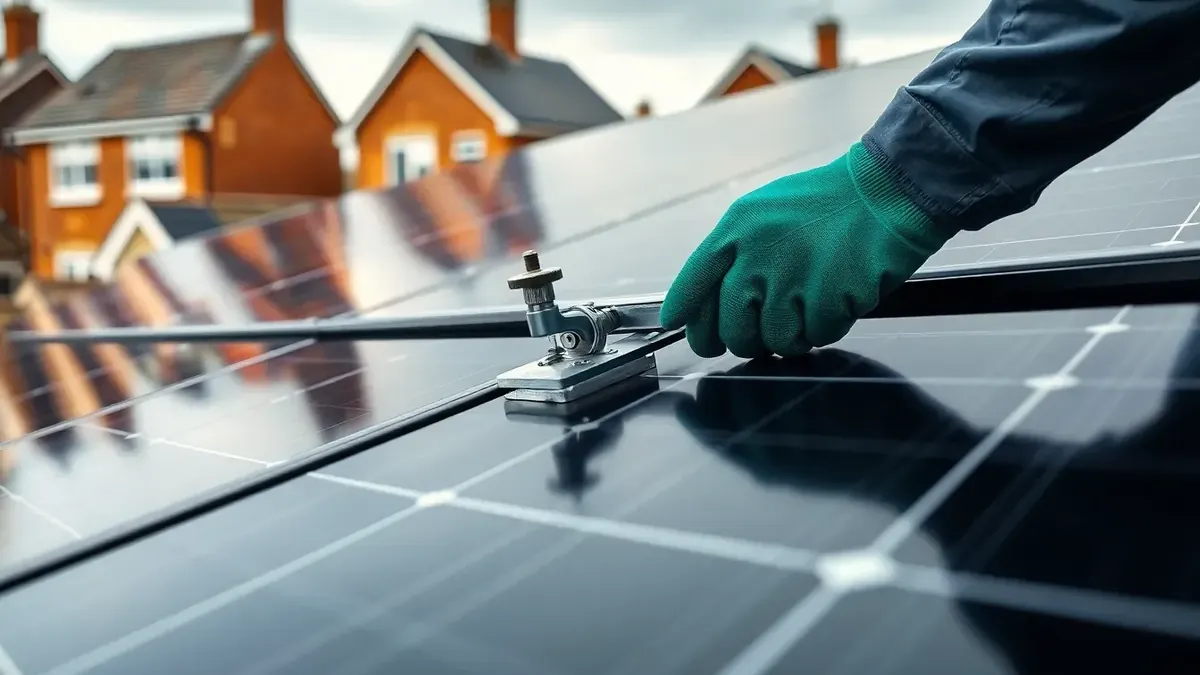
So, how much do solar panels cost in the UK? A typical home system of 4 to 4.5 kWp typically costs roughly £6,000 to £8,000 installed. That range comes from government cost data and the Energy Saving Trust, and it covers panels, inverter, mounting and fitting.
Your own price will land somewhere inside that range, or just outside it. That is because the size of the system, the shape of your roof and the equipment you choose all move the figure. This guide explains each of those drivers in plain English, so you can read a quote with confidence.
What a typical UK system costs
The Department for Energy Security and Net Zero publishes cost data collected through MCS, the UK quality mark for small-scale renewables. In 2025/26, for example, the median installed cost was about £1,595 per kW for systems up to 4 kW. For systems between 4 and 10 kW it was about £1,546 per kW.
Those figures make the sums easy. A 4 kWp system works out at roughly £6,200 to £7,200, while a 4.5 kWp system comes to roughly £7,000 to £7,300. The Energy Saving Trust quotes about £7,600 for 4.5 kWp, and MCS says the average certified home system cost just over £7,000 in 2025.
Prices have also been moving in the right direction, so the trend is helpful. After inflation, the median cost per kW fell by 7% for the smallest systems and 9% for mid-sized ones in 2025/26, according to the same government data.
| System size | Roughly how many panels | Typical installed cost |
|---|---|---|
| 4 kWp | 9 to 10 | About £6,200 to £7,200 |
| 4.5 kWp | 10 to 11 | About £7,000 to £7,600 |
These rows are indicative. They use the government per-kW figures above, so treat them as a guide and not a quote. The panel counts assume modern panels of 400 to 450 watts, which our guide on how many solar panels you need explains in more detail.
What drives the price up or down
Several things explain why two similar homes get different quotes. Knowing them helps you spot a fair price, since you can see what each line pays for.
- System size. More panels cost more, although the price per kW usually falls as the system grows.
- Roof access. A tall house or a tricky roof needs more scaffold and more time.
- Panels or tiles. The Energy Saving Trust lists whether you choose panels or tiles, and whether panels are integrated into the roof, as cost drivers. Our comparison of in-roof and on-roof panels covers that choice.
- Roof condition. If the covering needs renewing first, that adds to the job.
- Equipment. Inverter type, panel quality and monitoring all change the price.
Because every roof differs, a proper design matters more than a headline price. A good design sizes the system to your use and your roof, so you do not pay for panels that cannot earn their keep. That is the heart of bespoke solar system design, which is the first thing Pier Solar does for each enquiry.
VAT and why timing matters
Installing solar panels in a home in England, Scotland or Wales is currently VAT-free, until 31 March 2027. HMRC’s notice says the rate returns to the reduced 5% from 1 April 2027, unless the government changes it.
This relief covers homes, however. Business buildings are normally charged standard-rate VAT, so check with an accountant. Home batteries installed with solar panels, or added later, are also covered by the same relief.
For a £7,000 system, a 5% rate would add about £350. That is a real sum. Still, it is no reason to rush a poor decision. Instead, plan your survey and design early enough that fitting can finish before the deadline if that matters to you.
Adding a battery
Panels make power during the day, yet most homes use more of it in the evening. A battery stores the surplus so you can use it later. The Energy Saving Trust gives a range of £1,500 to £10,000 for a home battery, with about £4,600 for a 5 kWh unit. Retail prices quoted by Which? start from about £2,500.
A battery is not essential for every home. If someone is in during the day, panels alone may use most of what they make, because they use it as it arrives. Our guide to battery storage costs and sizing helps you decide.
Are there grants to bring the cost down?
There are no dedicated UK Government solar panel grants, according to the Energy Saving Trust. Some low-income households in England may get help through the Warm Homes: Local Grant. Eligibility is narrow, therefore read our guide to solar panel grants and schemes before you count on any help.
Running costs and long-term value
Solar panels have few moving parts, so running costs are low. As a result, upkeep is light. Panels should typically last 25 years or more. The inverter usually needs replacing after about 12 years, so it is wise to set that cost aside. Our short guide to solar panel maintenance and cleaning explains what upkeep to expect.
The value you get back depends on how much of your power you use and how much you export. The Energy Saving Trust puts payback at roughly 9 to 12 years in its example locations. Our article asking whether solar panels are worth it in the UK looks at that in more depth.
How to compare quotes fairly
A fair comparison starts with the same specification, because otherwise the prices mean different things. Ask each firm to quote for the same system size and to list the panel make, inverter make, and what the price includes. Check these points on every quote.
- The kWp size and the number of panels.
- Scaffolding, electrical work and the network operator paperwork.
- Whether the installer is MCS certified, so you can claim Smart Export Guarantee payments.
- Warranty terms for panels, inverter and workmanship.
- Monitoring, and whether the design leaves room for a battery.
Pier Solar designs and specifies your system, and vetted MCS-certified partners install it. That keeps the design independent of any one price list, while the install stays with certified hands. If you want a clear specification to compare, send your details through our online enquiry form for a solar design.
The right equipment matters as much as the right price, since it sets how well the system performs. Our page on premium panel and inverter installation explains how it is chosen and fitted. City households often ask us the same questions, so we have also written about solar installation in Manchester, solar installation in Leeds and solar installation in Liverpool.