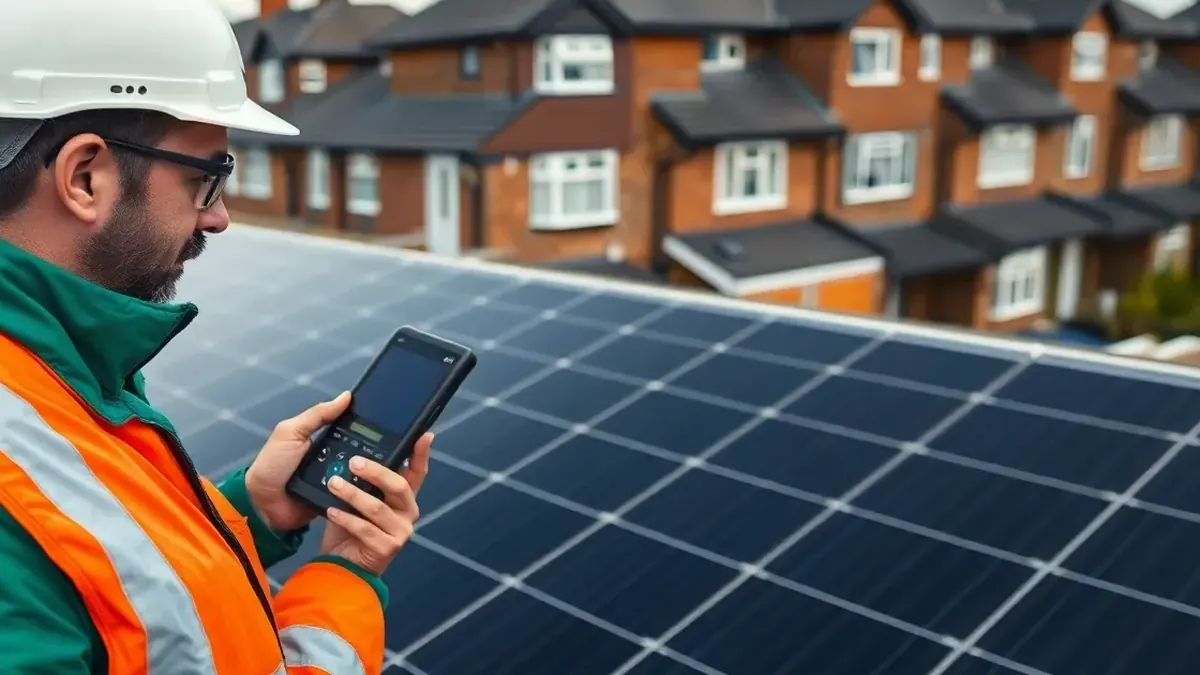
Solar panels should typically last 25 years or more. That is the view of the Energy Saving Trust and of MCS, the UK quality mark for small-scale renewables. The panels have no moving parts, so they wear slowly.
However, a solar system is more than panels. The inverter and any battery wear out sooner, and the roof underneath matters too. This guide shows how long each part lasts, how fast output fades and what you can do to protect your investment.
How long each part lasts
Different parts of a system age at different rates. The table below uses figures from the Energy Saving Trust.
| Part | Typical life |
|---|---|
| Solar panels | 25 years or more |
| Inverter | Around 12 years |
| Home battery | About 10 to 12 years |
The panels are the long-lived part, while the inverter is the part most owners replace once. A battery, if you have one, may also need replacing during the panels’ life.
Because of this, plan for at least one inverter swap in your budget. Our guide to solar inverters explained covers the types and what they cost to replace.
Do solar panels stop working after 25 years?
No. A 25-year figure is a planning guide, not a cliff edge. Panels do not switch off on their 25th birthday. They keep making power, but a little less each year.
That slow fade is called degradation. Specifically, the MCS page says panels can last over 25 years, and that the inverter may need replacing within that time. Most owners keep systems running well beyond the point where they have paid for themselves.
How fast does output fade?
A well-known review looked at field studies of panels. It was written by researchers at the US National Renewable Energy Laboratory. The median loss was about 0.5% of output per year. The mean was 0.8%, and 80% of the reported rates were below 1% a year.
Here is what that means in plain numbers. For example, at 0.5% a year, a panel would still make roughly 88% of its first-year output after 25 years. That is our own arithmetic from the median, so it is a guide only. Your panels may fade faster or slower.
Some factors affect the rate.
- Heat and strong sun, which age the materials over time.
- Poor quality cells or poor manufacturing.
- Damage from hail, falling branches or rough handling.
- Dirt and shade, which cut output but do not harm the panel.
Warranties: what is covered
Warranties give you protection on parts. Most panels come with manufacturer product and performance warranties. Read the paperwork for the exact terms, because they differ between brands. We do not quote percentages here, since they vary by product.
Inverter warranties commonly start at five years at least. You can often extend them up to 15 years. A battery has its own warranty too.
The workmanship is a separate matter, because a product warranty will not cover a poor fitting. Pier Solar arranges manufacturer product warranties plus an extended workmanship warranty, so you have cover on both. Our extended workmanship warranties page explains what that cover means in practice.
What shortens a system’s life
Faults can come from the install as well as from the panel. A weak roof fixing can let water in. Poor cable work can cause faults. A competent person must check your roof can carry the panels before installation, and a good design avoids shade.
Weather matters less than you might expect. In fact, UK rain helps keep panels clean, because panels tilted at 15 degrees or more tend to clean themselves. Heavy snow can cover panels and pause output until it clears. Strong wind is why the mounting design and fixings are so important.
Your roof is also part of the system. If the roof needs work soon, do it before the panels go on. Otherwise, you pay twice to take the array off and put it back.
How to protect your system
Good habits keep a system healthy for decades.
- Keep an eye on your output every month or so. A drop that is not explained by weather is a warning sign.
- Clear heavy debris and check for bird nesting under the panels.
- Keep trees trimmed so they do not shade the array.
- Book a periodic professional check, especially of the inverter and the cabling.
- Keep your paperwork, including the MCS certificate and warranty documents.
Our system health checks service looks at output, wiring and the inverter, and flags small problems early. You can also read our guide to solar panel maintenance and cleaning for what you can safely do yourself.
Does lifespan change the maths?
Yes, it does. The longer a system runs, the longer it earns its keep. When you weigh up cost and payback, use a life of 25 years or more for the panels, and a shorter life for the inverter and battery. The Energy Saving Trust puts payback at roughly 9 to 12 years in its example locations. After that, you gain from each unit you generate.
A larger system can also be worth the extra cost over such a long life, although it must suit your use. Our guide on how many solar panels you need helps you size it. Our guide to solar battery storage costs shows why a battery needs its own lifespan check. If you plan to sell electricity back, the Smart Export Guarantee explained covers the contract side.
Rules that can affect an older system
Rules change over time. For instance, England updated its permitted development rules on 27 August 2026, and Scotland and Wales have their own. If you add to a system later, check whether you need consent. Our guide on planning permission for solar panels covers this. In Scotland, see solar panels in Scotland for local points.
Lifespan across the UK
Output depends on where you live, yet lifespan is similar across the country. A system in Yorkshire or the North West faces the same ageing processes as one on the south coast. What differs is how much power it makes each year. Meanwhile, PVGIS models about 950 kWh per kWp in Leeds and Sheffield, and about 970 in Liverpool, at the best angle. Those are modelled estimates, and real roofs make less.
For local detail, see solar installation in Leeds, solar panels in Liverpool and solar power in Sheffield.
Next steps
Ask any installer for the warranty documents before you sign. Check who looks after the workmanship cover and for how long. When you are ready, use our online enquiry form to start a design with Pier Solar. We design the system, and a vetted MCS-certified partner installs it.