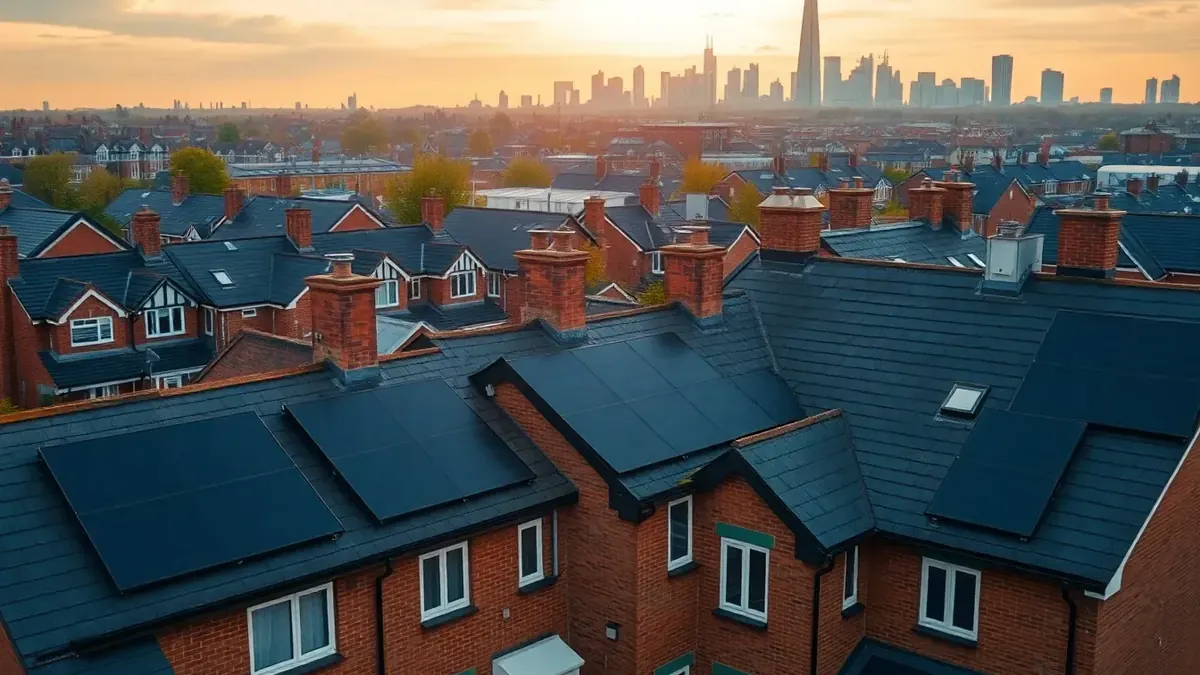
Are solar panels worth it in the UK? For many homes with a good roof, yes, although the answer depends on your roof, your use and the price you pay. The Energy Saving Trust puts payback at roughly 9 to 12 years in its example locations, and panels should typically last 25 years or more.
That gap between payback and lifespan is where the value sits. This guide shows what drives the result, using sourced figures, so you can judge your own case before you ask for quotes.
What “worth it” means
Worth it can mean three things. It might mean saving money over the life of the system. It might mean cutting your carbon, or protecting yourself against rising bills. Most people want a mix, but money is the usual starting point.
The money case rests on two flows. First, each unit of solar power you use saves the unit rate you would otherwise pay. Second, each unit you export earns a payment under the Smart Export Guarantee. Using power at home is normally worth more than exporting it, so the best designs favour self-use.
What the price cap tells us
The Ofgem price cap for 1 October to 31 December 2026 sets electricity at about 26p per kWh. The cap changes every quarter, so that rate is a snapshot and not a promise. Domestic electricity VAT is also zero until 31 March 2027, which lowers the value of each unit you save.
The lesson is simple. Solar value moves with the price of power, so a single payback figure always carries some uncertainty. Be wary of any quote that gives you one precise number for 25 years.
How much power will panels make?
Location matters, but less than people expect. Using the EU’s PVGIS tool, a well-placed 1 kWp of panels in the UK typically makes about 850 to 1,150 kWh a year, depending on location. The modelled range runs from about 850 in Glasgow to about 1,160 in Brighton, at the best angle.
A typical home uses about 2,500 kWh of electricity a year, according to Ofgem’s medium consumption figure. A typical 4 kWp system therefore covers a large share of that over the year, although not at the right times of day.
| Place | Modelled yearly output of 1 kWp |
|---|---|
| Glasgow | About 850 kWh |
| Manchester | About 890 kWh |
| Sheffield | About 950 kWh |
| Birmingham | About 970 kWh |
| Brighton | About 1,160 kWh |
These are modelled estimates at an ideal angle with 14% system losses, so real roofs usually make less. If you live in a northern city, our pages on solar installation in Sheffield and solar installation in Glasgow show how design adapts to local conditions. The same goes for solar installation in Edinburgh, where older streets bring extra planning checks.
Your roof changes the result
A south-facing roof at a 30 to 45 degree pitch is ideal. PVGIS modelling for Birmingham shows that east or west roofs typically still make about 80% of the best output. A flat roof makes about 83%, while a steep north-facing slope falls to around 54% to 70%.
Shade matters too, because even a chimney shadow can cut output across a string of panels. For that reason a survey and a careful layout come before any price. This is what bespoke solar system design is for, and it is why Pier Solar designs first and passes a clear specification to certified partners.
Winter, cloud and the seasons
Panels still generate in winter and on cloudy days, but December output is typically about a third of July’s. In the Birmingham model, May to August brings roughly 47% of the year’s output, while November to January brings roughly 12%.
That seasonal pattern is the reason many households look at storage. Our guide to solar battery storage costs and sizing explains when a battery adds value and when it does not. Our battery storage systems page shows how the hardware is specified. In Scotland the pattern is sharper, so read our notes on solar panels in Scotland too.
Getting paid for exports
The Smart Export Guarantee pays you for surplus solar electricity you send to the grid. Larger energy suppliers must offer an export tariff, and some smaller suppliers offer one too. Each supplier sets its own rate, so compare tariffs before you choose.
To join, you need an MCS-certified system and a meter that records what you export. Our explainer on the Smart Export Guarantee covers the steps. We do not quote a rate here, because rates differ by supplier and change often.
Cost, VAT and long-term running
A typical 4 to 4.5 kWp home system typically costs roughly £6,000 to £8,000 installed, according to government data and the Energy Saving Trust. Installing solar panels in a home in England, Scotland or Wales is currently VAT-free, until 31 March 2027. From 1 April 2027 the rate is due to return to 5%, unless the government changes it.
Running costs are low. The inverter usually needs replacing after about 12 years, and panels slowly lose output, typically around half a percent a year. Our article on how long solar panels last goes into the detail.
Planning and paperwork
Most homes can add panels without a planning application, although there are limits. In England, on a pitched roof, panels can stick out no more than 20 cm and must stay below the highest point. A listed building needs consent before you add solar panels. Our guide to planning permission for solar panels sets out the rules by nation.
Your installer normally handles the network operator application or notification. As a result, the paperwork rarely falls on you.
A quick checklist
Solar is more likely to be worth it if most of these apply.
- Your roof faces roughly south, east or west and has little shade.
- You use a fair amount of power during the day, or plan to store it.
- You plan to stay in the home for at least a decade.
- Your roof covering is sound, so you will not need to remove panels soon.
- You choose an MCS-certified installer and compare like-for-like quotes.
If you are unsure, the cheapest next step is a design review. Describe your home through our online enquiry form for a solar design, and Pier Solar will say plainly whether solar looks sensible. We would rather tell you it is not worth it than sell you a poor fit.
Sources
- Energy Saving Trust — Solar panels for your home
- Ofgem — Changes to the energy price cap, 1 October to 31 December 2026
- Ofgem — Smart Export Guarantee
- European Commission JRC — PVGIS photovoltaic geographical information system
- HMRC — VAT on energy-saving materials and heating equipment (Notice 708/6)
- NREL — Jordan and Kurtz, photovoltaic degradation rates
- Planning Portal — Solar panels and planning permission