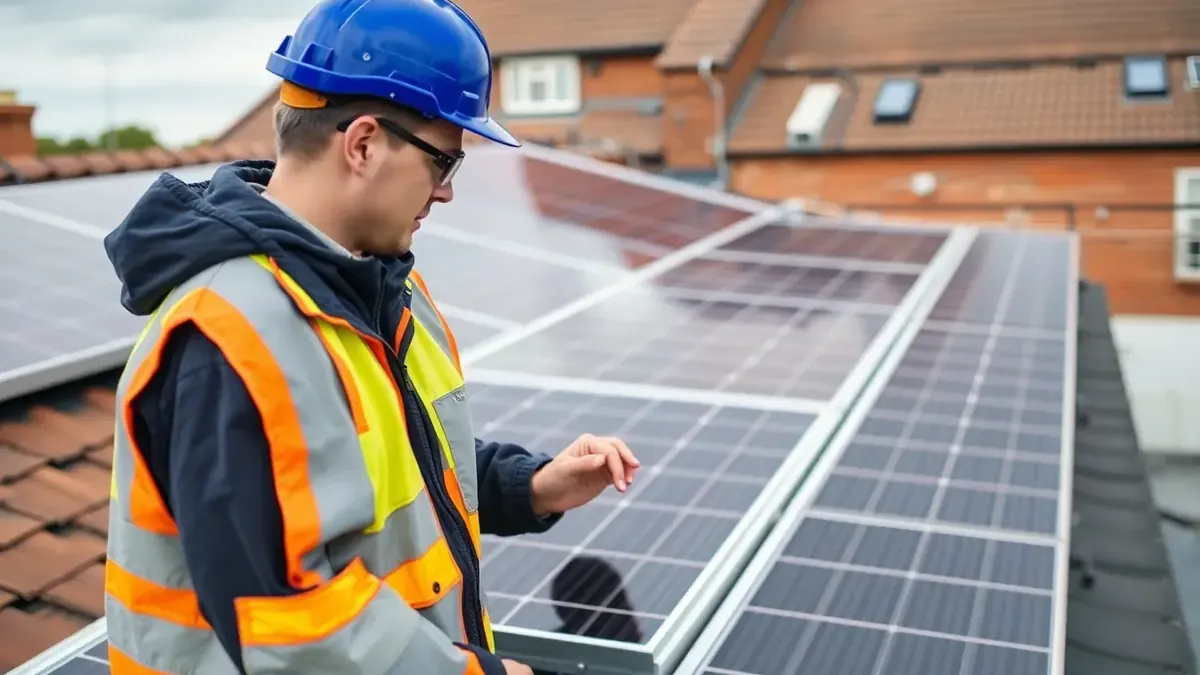
MCS certification is the UK quality mark for small-scale renewable installations, including solar panels. MCS stands for the Microgeneration Certification Scheme. It sets standards for the installers who fit your system and for the products they use.
For homeowners, the practical point is simple. You normally need an MCS certificate to be paid for the power you export. It is also a sign that your installer has been checked. This guide explains what the scheme covers, what to ask for and how to spot a problem.
What MCS certification covers
MCS looks at two things: the company and the system. The installer must meet the scheme’s standards, and the equipment must meet product standards too. The scheme also sets an installation standard for solar PV, which covers design and fitting.
Part of that standard deals with your roof. Specifically, a competent person must check that the roof can carry the panels before installation. A structural engineer may be needed for an unusual roof. The standard also covers wind effects at roof edges, which is why a proper design matters.
In short, the certificate shows that a qualified firm designed and fitted your system to a recognised standard. It does not promise a set level of savings, because it is proof of quality rather than a guarantee of output. Your output still depends on your roof, your shade and your weather.
Why the certificate matters
There are three main reasons to care.
- Export payments. The Smart Export Guarantee asks for an MCS certificate, or an equivalent scheme, as proof of your installation. Our guide to the Smart Export Guarantee explains the scheme.
- Protection. MCS installers who sell to homeowners belong to a consumer code, which has a complaints process.
- Records. The certificate is a record of who installed your system and when.
Without a certificate, you may be unable to join an export tariff. As a result, you could lose export income for years. Check before you pay a deposit.
When you get the certificate
Your installer should give you an MCS certificate within about ten working days of finishing the work. This is part of the standard process, not an extra. However, if it has not arrived, ask for it in writing.
Keep the certificate with your warranty papers. You will need it when you apply to an export tariff. Our guide to how long solar panels last explains why those papers matter for many years.
Consumer codes: RECC and HIES
Two consumer codes are common in the sector. One is the Renewable Energy Consumer Code, or RECC. The other is the Home Insulation and Energy Systems Contractors Scheme, or HIES. MCS installers who sell to households belong to an approved code.
A code gives you a route for complaints if the work or the sales process goes wrong. Ask the installer which code they follow, and check the code’s own website. Do this before you sign a contract, since it is hard to fix afterwards. Meanwhile, keep every quote, email and design in one folder.
How to check an installer
You can do most of this in an evening.
- Ask for their MCS registration, and check it on the MCS website.
- Ask which consumer code they belong to.
- Ask who will do the work, and whether they use subcontractors.
- Ask what workmanship cover comes with the job, and for how long.
- Ask for a written design that shows panel layout and expected output.
Be wary of high-pressure sales. A good firm gives you time, because it has nothing to hide. It will explain the design and put the price in writing.
How Pier Solar works with MCS partners
Pier Solar designs and specifies your system. We then coordinate installation through vetted, MCS-certified installation partners across the UK. This means the people on your roof hold the right certification. Because we stay involved in the design and checks, you have one point of contact.
Our MCS-certified installations service describes how that works from survey to handover. We also arrange manufacturer product warranties plus an extended workmanship warranty. Read about our extended workmanship warranties to see what the cover means.
Planning, cost and business use
MCS is one step in a longer process. Planning rules come first for some homes, so read our guide on planning permission for solar panels. Cost is the next question, and how much solar panels cost in the UK sets out typical ranges.
Small firms are not left out. For example, if you want solar for a shop, workshop or office, see our guide to solar panels for business premises. Your inverter also matters, and solar inverters explained covers the main types.
Local points in Scotland and the South West
The certification rules are the same across the UK, but local conditions are not. For instance, planning limits differ by nation. In Scotland, Class 6HA lets most homes add solar without a planning application. The Old and New Towns of Edinburgh World Heritage Site and the large New Town conservation area add extra checks, so read about solar installation in Edinburgh before you plan. For a larger city view, see solar panels in Glasgow.
Meanwhile, in the South West, some councils have run group-buying schemes. Solar Together West of England ran rounds in 2021, 2023 and 2025, though registration was closed when we checked. Our page on solar power in Bristol has local detail. A group scheme still needs a certified install, so the same checks apply. Therefore, ask any scheme provider which installers they use.
What MCS does not do
MCS does not set the price. It also does not choose your roof layout or guarantee your bills. Instead, it makes sure the work meets a known standard, and it gives you a paper trail.
It does not replace a good contract either. Read the terms on deposits, timing and cover, because they matter just as much. Although MCS gives you a base level of trust, you should still compare quotes and ask questions.
Red flags
Treat these as a reason to stop and ask questions.
- The firm cannot show an MCS registration.
- They promise a fixed saving or a quick payback.
- They push you to sign on the day.
- They call a scheme free, or imply a grant that everyone can claim.
- They will not put the workmanship cover in writing.
There are no dedicated UK Government solar panel grants, according to the Energy Saving Trust. Some low-income households may get help through other schemes, so check what is open.
Next steps
Decide what you want your system to do, then ask for a written design. Since the design drives the price, compare at least two. When you are ready, use our online enquiry form to start. Tell us about your roof, your usage and your area.
Sources
- MCS: Solar photovoltaic (PV) for consumers
- MCS: What to do if things go wrong
- MCS: MIS 3002 Solar PV Systems installation standard
- Renewable Energy Consumer Code (RECC)
- Ofgem: Smart Export Guarantee generator guidance
- Energy Saving Trust: Solar panels
- West of England Combined Authority: Solar Together
- City of Edinburgh Council: Listed buildings and conservation areas