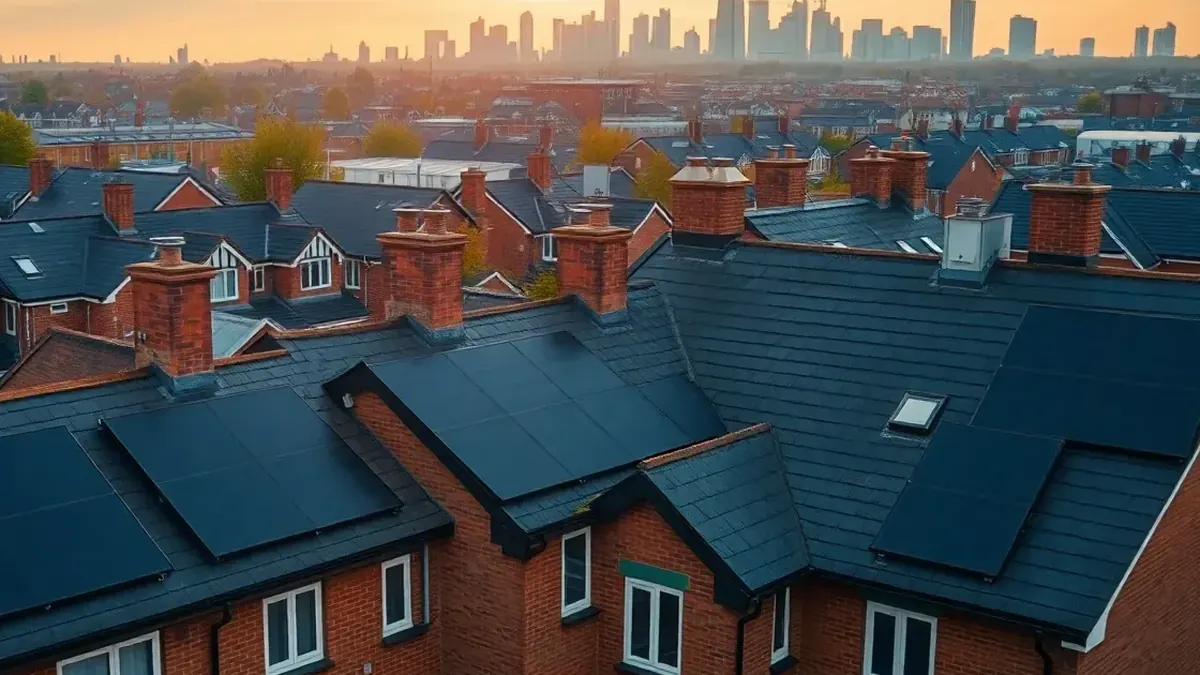
Solar panels for business can cut the electricity you buy during the day. A shop, office, workshop or small unit often uses most of its power while the sun is up. That is a good match for solar, because you use the power as you make it.
However, the rules for firms differ from those for homes. VAT, tax relief, planning and business rates all work in their own ways. This guide explains the main points for small UK businesses, and flags where you need an accountant or your council.
Why daytime use matters
A solar system makes power in daylight. If your business runs from nine to five, much of that output goes straight into your own use. Each unit you use yourself saves the unit rate you would otherwise pay.
Ofgem’s price cap gives a guide to prices. It puts the average domestic electricity rate at about 26p per kWh from October to December 2026. Business tariffs differ, so look at your own bill. Still, the point is the same: power you make and use is power you do not buy.
Any surplus is different, because you can send it to the grid, and in many cases earn export payments. Our guide to the Smart Export Guarantee covers how that works. The scheme covers solar PV up to 5 MW in Great Britain, so small firms can qualify. As with homes, you normally need an MCS-certified system and a meter that records your export.
Check your load first
Before you pick a size, look at when you use power. Your meter data or bills will show it. A business that is busy at midday suits solar well. A business that opens in the evening may see less benefit, unless it adds a battery.
Size also depends on roof space. For example, a typical home system is around 4 to 4.5 kWp, but a unit with a large flat roof can fit far more. Our guide on how many solar panels you need explains the sums. The same method works for a business, since you divide your target by the output of each panel.
VAT: homes and businesses differ
The zero rate of VAT on solar panels applies to residential accommodation and some charitable buildings. It does not cover business premises. As a result, business installs are generally charged standard-rate VAT.
Your VAT position depends on your business. Many firms can reclaim VAT on purchases, but not all can. Check with an accountant before you decide. The relief for homes is due to end on 31 March 2027, when the rate is due to return to 5%, unless the government changes it. That does not apply to business installs.
Tax relief and capital allowances
Businesses may be able to claim tax relief on solar. HMRC lists solar panels as special rate assets. The Annual Investment Allowance, which is £1 million, may apply, and other allowances may also be relevant.
Rules differ for companies, sole traders and landlords, and they change. Because the details are technical, ask an accountant before you sign. We cannot give tax advice, and a wrong assumption could be costly.
Business rates in England
In England, plant and machinery that generates power mainly from renewable sources is excluded from rateable value. This includes photovoltaics. The exclusion covers days before 1 April 2035 and came into force on 1 April 2022. That means rooftop solar equipment is currently left out of your business rates valuation.
We have not checked the position in Scotland or Wales, so ask your local authority or adviser if you are there. Meanwhile, remember that rules can change before 2035.
Planning and the roof
Business buildings follow different planning rules from homes, so check with the council first. Listed buildings and conservation areas add extra checks. Our guide to planning permission for solar panels covers homes, but the council is always the final word for a business.
Your roof matters just as much, since a competent person must check that it can carry the panels before installation. A flat roof, a pitched roof and an in-roof system each need a different design. If you are weighing options, read about in-roof versus on-roof solar panels.
If you rent your premises, speak to your landlord early. The lease may limit changes to the roof, and you will also want to know who owns the panels and who gets the savings.
Network connection
Your local network operator needs to know about any generation. Small systems up to 3.68 kW per phase are notified within 28 days of installation. Larger systems need approval before the installer connects them. A business system often exceeds the small limit, so allow time for approval.
Your installer normally handles the paperwork. Do not promise customers or staff a switch-on date until the operator has approved.
Cost and payback
We do not quote a business price here, because it depends on size, roof and wiring. Government cost data mixes home and business installs, so it does not give a clean figure for firms. For a rough idea of how cost works, read how much solar panels cost in the UK. Then ask for a written quote for your own site.
Payback also varies. The Energy Saving Trust gives examples for homes of roughly 9 to 12 years in its sample locations. A business can differ, because it often uses more power in the day and pays different rates. Our guide on whether solar panels are worth it shows how to think about the sums.
There are no dedicated UK Government solar panel grants, according to the Energy Saving Trust. Our overview of solar panel grants and schemes explains what exists, and most of it is for households. Do not assume your business can claim.
Monitoring and control
A business benefits from seeing its data. Specifically, monitoring shows when you make power, when you use it and when you export. You can then move heavy loads, such as a kiln, a compressor or a dishwasher, to the sunny hours. Our smart energy monitoring service sets this up. Our premium panel and inverter installation service covers the main hardware.
Solar output across the UK
Output depends on place. For instance, the PVGIS tool models about 980 kWh per kWp per year in Nottingham, 1,030 in Cardiff and 1,040 in Norwich at the best angle. Those are modelled estimates, and real roofs make less. For local detail, see solar installation in Nottingham, solar panels in Cardiff and solar power in Norwich.
How we work with businesses
Pier Solar designs and specifies each system. Vetted, MCS-certified partners then install it. We arrange manufacturer product warranties plus an extended workmanship warranty. Use our online enquiry form to tell us about your site, your hours and your roof, and we will take it from there.
Sources
- GOV.UK: VAT on energy-saving materials and heating equipment (Notice 708/6)
- GOV.UK: Work out your capital allowances, rates and pools
- GOV.UK: Annual Investment Allowance
- Legislation.gov.uk: Statutory Instrument 2022/405, business rates and renewable plant and machinery
- Ofgem: Smart Export Guarantee generator guidance
- Ofgem: Changes to the energy price cap, 1 October to 31 December 2026
- Energy Saving Trust: Solar panels
- SSEN: Micro-generation connections, installations up to 3.68kW per phase
- European Commission JRC: PVGIS